Swiss testimony surfaces on Bouvier deal for ‘Salvator Mundi,’ painting later referenced by Epstein
Court documents reveal how a Paris dinner helped seal the painting's 2013 private sale.

Court documents reveal how a Paris dinner helped seal the painting's 2013 private sale.
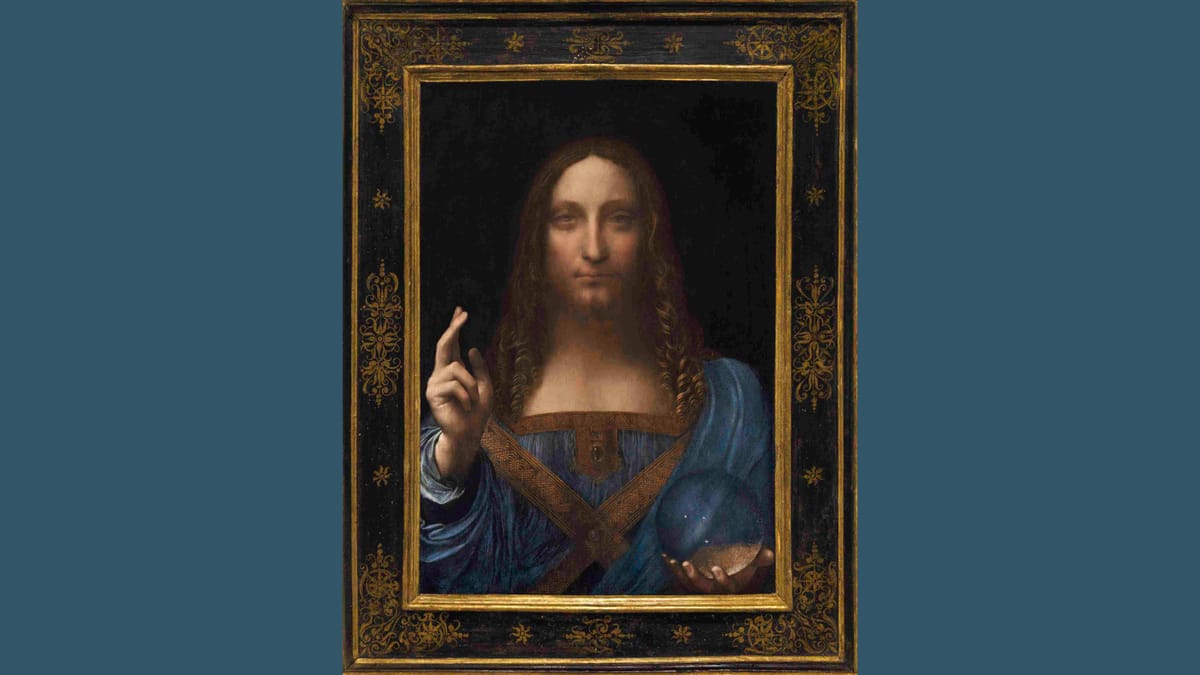
Newly surfaced Swiss testimony describes how an art-world intermediary negotiated the 2013 private sale of Leonardo da Vinci’s Salvator Mundi for dealer Yves Bouvier, years before the painting resurfaced in Jeffrey Epstein’s emails as a subject of conspiracy-minded speculation.
Art-world intermediary Jean-Marc Peretti gave the testimony while being questioned by prosecutors in Geneva on December 1, 2022, during a Swiss criminal investigation tied to Russian billionaire Dmitry Rybolovlev’s long-running dispute with Bouvier. In the hearing minutes, Peretti is listed as a person called to provide information.
The testimony appeared as an exhibit in court documents obtained by Urgent Matter that were filed in U.S. federal court as part of Bouvier’s separate effort to obtain American banking and auction records for use in litigation in Hong Kong.
The painting at the center of the testimony, Salvator Mundi, has one of the most scrutinized ownership histories in the art market.
The work was acquired in a Sotheby’s-brokered private sale for about $80 million by dealers including Bouvier in May 2013. Shortly afterward, Bouvier resold the painting to Rybolovlev for $127.5 million through an offshore company linked to the collector.
Rybolovlev later accused Bouvier of secretly inflating prices on a number of artworks he purchased through the dealer, sparking the years-long global legal feud. Bouvier has denied wrongdoing and has argued he was acting as a principal dealer who was free to set resale prices.
In 2017, Salvator Mundi became the most expensive artwork ever sold when it fetched $450.3 million at Christie’s in New York. The buyer was widely reported to be acting on behalf of Saudi Arabia’s Crown Prince Mohammed bin Salman.
 Adam Schrader
The latest release of Epstein files from the U.S. Justice Department included an email the convicted sex offender sent on May 30, 2019, to reporter Michael Wolff about the painting, though he did not refer to it by name. The reference in the Epstein files was first reported by Art News.
“Is it a coincidence that the Russian that bought the house in Palm Beach and knows all is the same guy that sold a painting last year to MBS for $450 million, that was only worth $1.5 million?” Epstein wrote to Wolff.
The reporter sent back: “So MBS was paying him off? Why? Ideas?”
“Reminder, Trump overruled congress on Yemen,” Epstein responded. “Maybe as a favor to Trump in exchange for Yemen and Iran support.”
The email exchange speculated that the $450 million sale might have been tied to geopolitical maneuvering, Artnet reported. In the messages, Epstein suggested that Rybolovlev’s profit on the painting could have functioned as a hidden payoff linked to U.S. policy toward Saudi Arabia during Trump’s first presidency.
There is no evidence the sale was connected to political favors or government policy. And the emails reflect Epstein’s speculation, not evidence of wrongdoing by the parties to the sale.
Peretti’s testimony adds new detail about how Salvator Mundi was negotiated during its 2013 sale, including the setting, the participants, and the price discussions.
“I acted as negotiator at Mr. Bouvier’s request so that he could acquire this work. In this capacity, I had instructions from Mr. Bouvier regarding the price,” Peretti said.
 Adam Schrader
Peretti said the negotiations occurred during a dinner meeting at Le Bristol, a hotel in Paris, and that the final price was verbally agreed at the end of the meeting.
“I believe I achieved the price set by Mr. Bouvier,” Peretti said. “When I say that the deal was concluded verbally, I mean that the deal went ahead afterwards, but I was no longer directly involved.”
Peretti said he was not compensated for his work in the deal. “As usual, it was an exchange of favors, even though this time I did more than just give my opinion. We do not charge an hourly rate,” he said. But he was reimbursed for the roughly EUR 500 meal.
“On the advice of my counsel, I would like to clarify that when I say that I did not receive any remuneration for the services rendered to Mr. Bouvier in connection with the above-mentioned acquisitions, this also includes my company Nelombos SA and my associates,” he said in the testimony.
Stories like this take time, documents and a commitment to public transparency. Please support independent arts journalism by subscribing to Urgent Matter and supporting our work directly.