Manhattan Mineral Club show places ancient art and crystals on the same pedestal
The exhibition pairs high-end mineral specimens with ancient art objects in a rare commercial test of whether the two markets can meet.

The exhibition pairs high-end mineral specimens with ancient art objects in a rare commercial test of whether the two markets can meet.
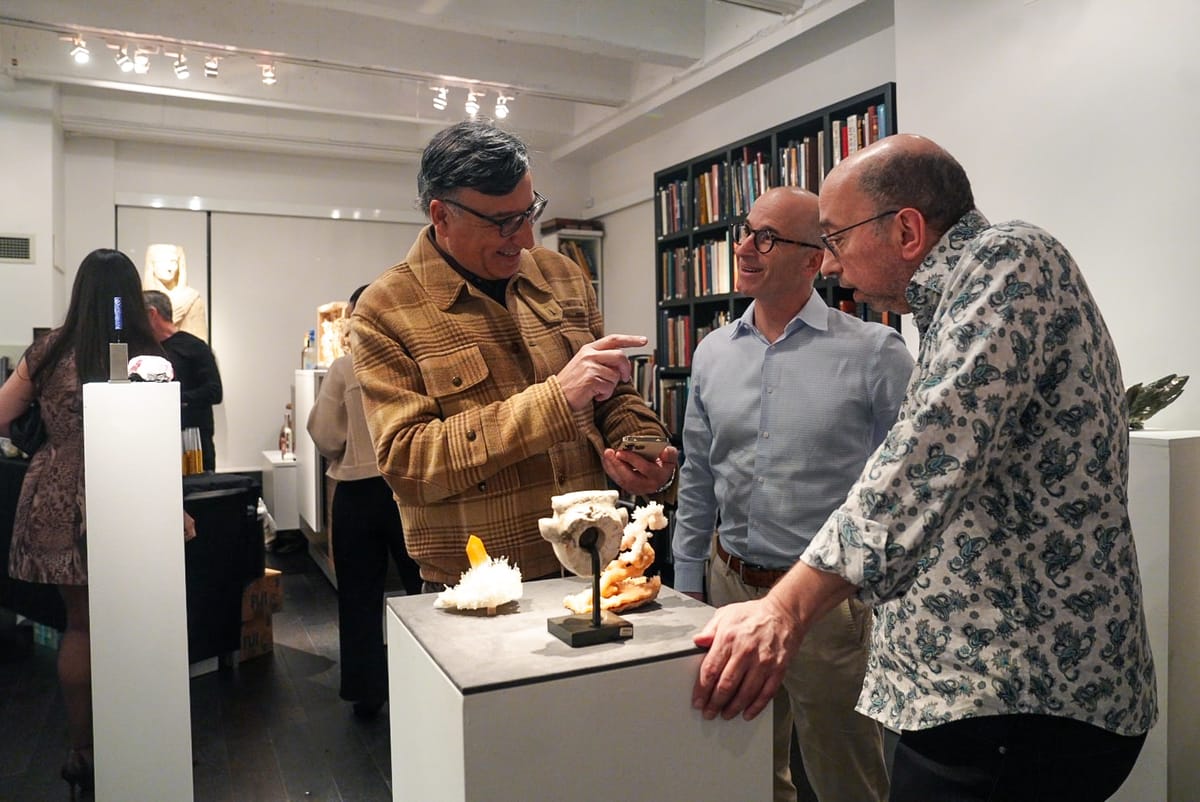
The Manhattan Mineral Club has staged an unusual experiment inside Trump Tower: an exhibition that presents ancient art and fine minerals side by side, treating geological specimens and carved antiquities as equals rather than curiosities from separate worlds.
The show, “Ancient Art Meets Minerals,” drew a steady crowd to its opening on Thursday, where visitors lingered over pairings that looked more like museum displays than a commercial presentation. Guests pointed out similarities between objects separated by millions of years.
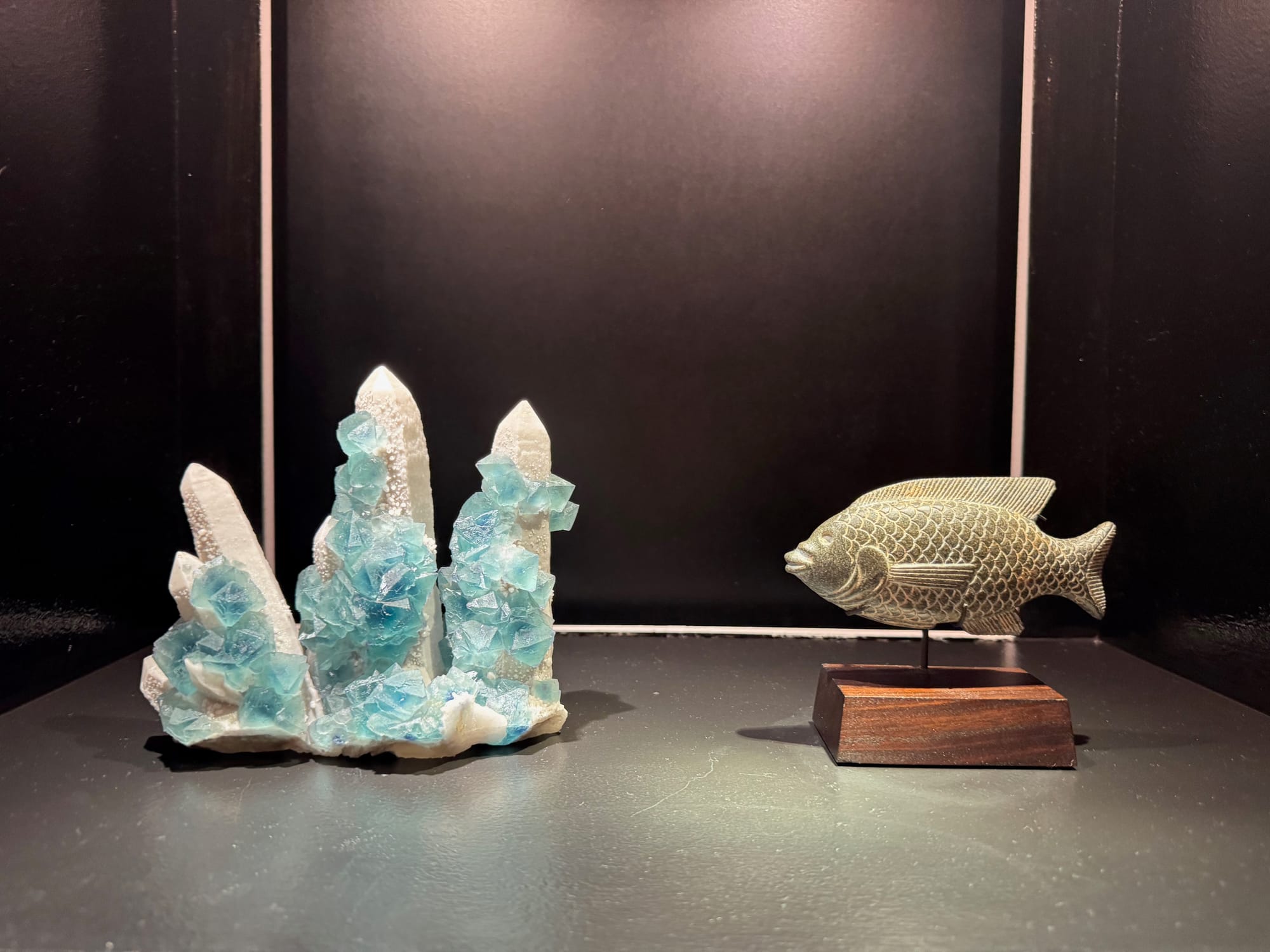
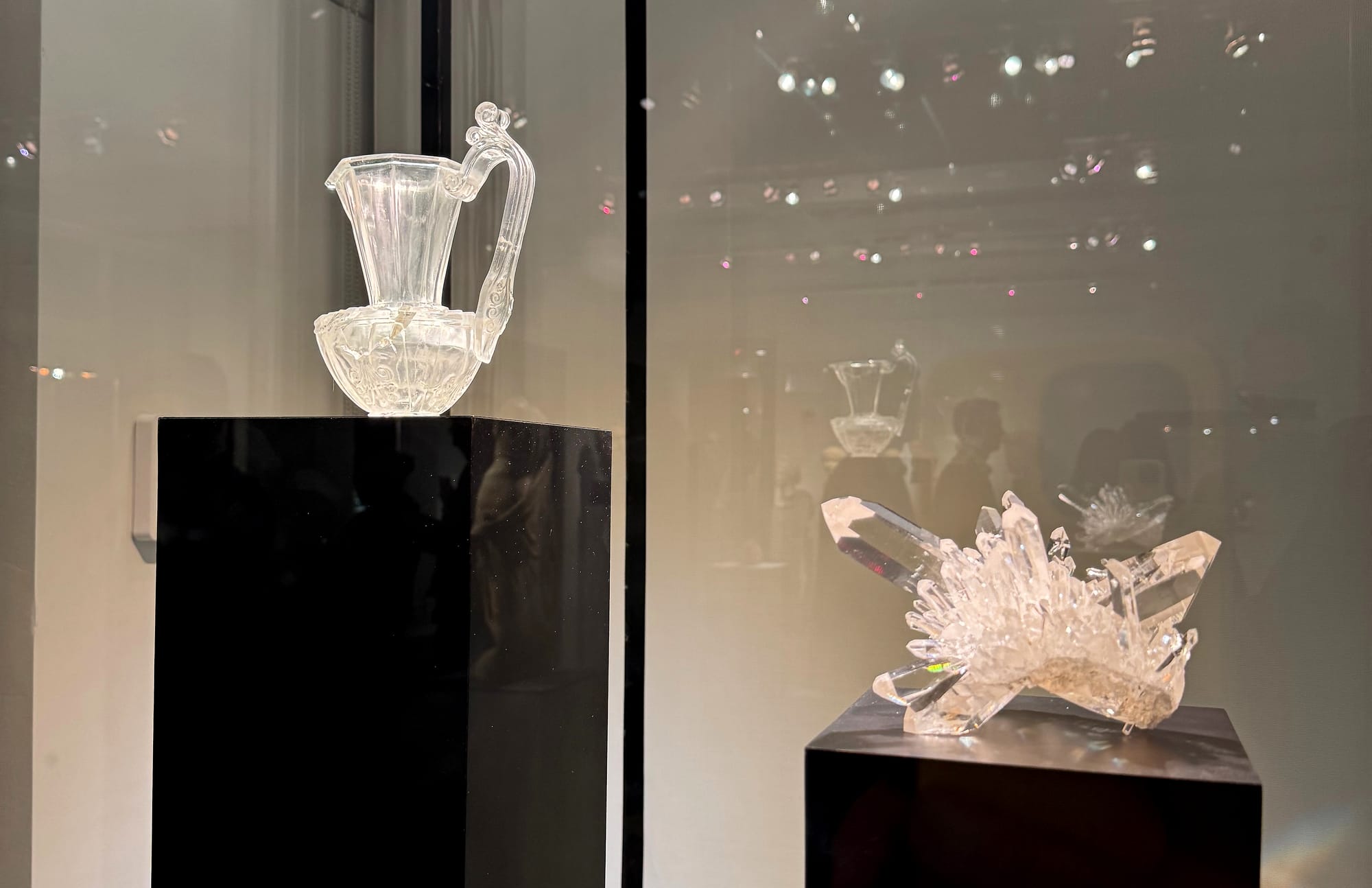
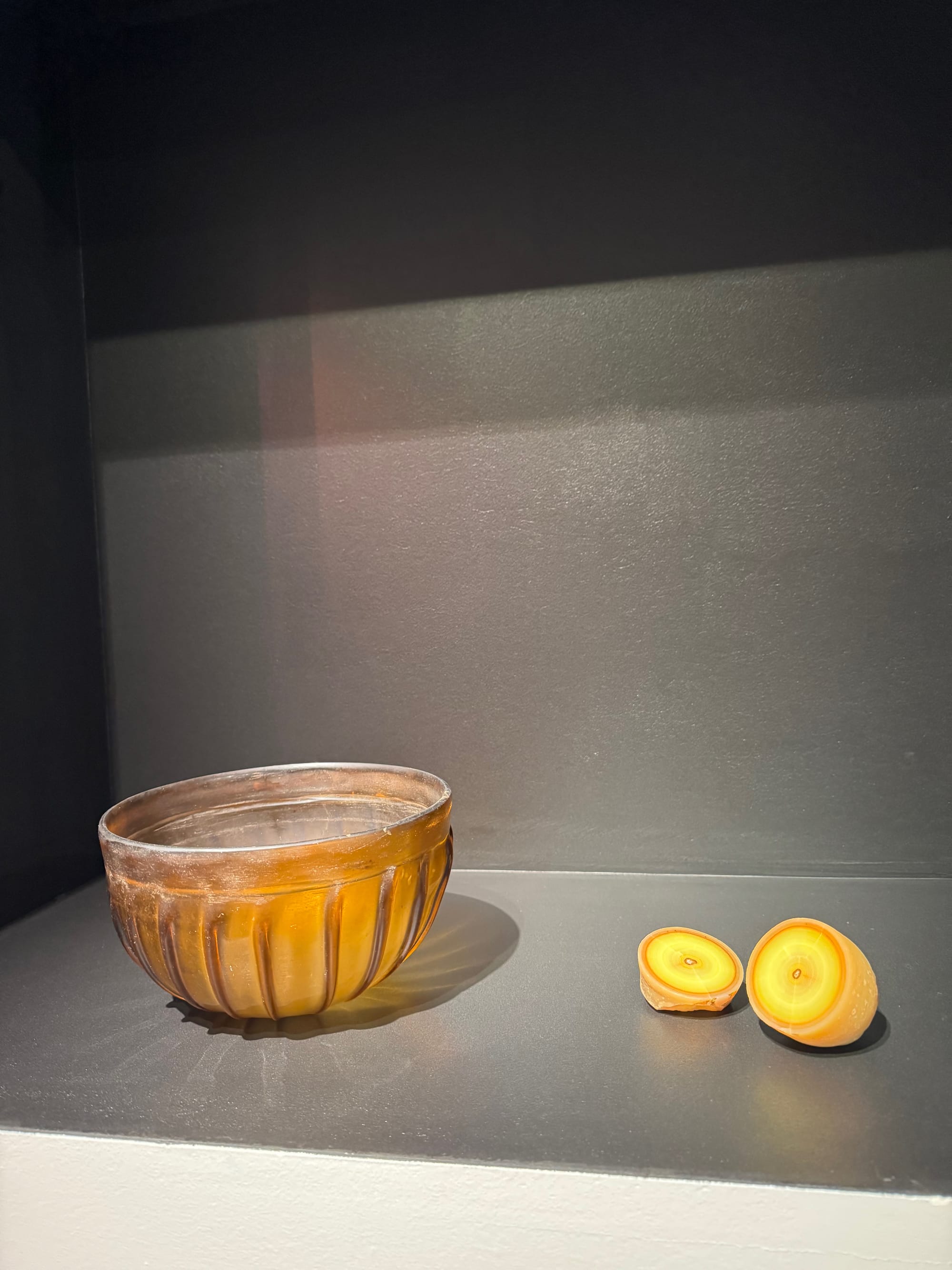
On one pedestal, a late Roman or Byzantine oinochoe carved from rock crystal sat beside a large specimen of the same material. Nearby, a pink agate amphoriskos dating back 2,000 years was paired with a vivid “candy opal” mined in Ethiopia. An Egyptian basalt cosmetic dish in the shape of a fish was shown with a quartz and blue fluorite cluster that jolted upward "like Poseidon’s trident,” as described by one of the gallerists behind the show.
Other examples of ancient artists using such minerals included a Sumerian cylinder seal carved from lapis lazuli, a sculptural right foot made of purple agate dating to ancient Rome and believed to have been possibly part of a larger statuette, and a red agate phiale from ancient Greece.
They are displayed alongside high-end mineral specimens such as rubellite tourmaline on clevelandite from the Malkhan Pegmatite Field in Siberia; tourmaline on lepidolite from Brazil’s Aricanga Mine with a prized color gradient of raspberry, mint and aquamarine; and mango quartz from Colombia, which was first discovered in 2017 and is trendy among mineral collectors.
Such tightly curated pairings are rare outside encyclopedic museums like the American Museum of Natural History. In the commercial art world, Urgent Matter could not identify another exhibition that places minerals and antiquities in direct dialogue.
The exhibition builds on the aesthetic language pioneered by Stuart Wilensky, a New York gallerist known for reframing minerals as fine art who closed his Chelsea doors in recent years. It was organized by Wilensky’s son, Troy Wilensky, with Alexander Aboutaam after they met last year at the Salon Art + Design show at the Park Avenue Armory.
Aboutaam is an artist who co-founded the studio Antico Contempo with his brother, Soliman Aboutaam. The studio specializes in creating modern interpretations of ancient art and work inspired by antiquities. Their father, Hicham Aboutaam, is president of Phoenix Ancient Art. Alexander Aboutaam is not an employee of Phoenix Ancient Art, but introduced Wilensky to the gallery and co-led the exhibition with him.

Troy Wilensky said he and Aboutaam originally had conceptualized doing one-to-one pairings, like the rock crystal oinochoe example, throughout the show but “realized it was a little complicated.” So, it is organized aesthetically around similar colors and gestures.
“We would love for them to stay together, but they are able to be purchased separately because there is still this divide,” Aboutaam said.
Wilensky said mineral specimens in the room ranged from about $5,000 to roughly $5 million—mirroring the range of the ancient art. Rarity and locality are among pricing factors. “But you can also collect minerals at a really fun level at the $100 range,” he said. “I have minerals in my collection from $100 to $500.”
Asked why include lower-priced minerals in a show where exceptional pieces hold center stage, Wilensky said the display levels the field visually. “You won’t be able to tell the difference," he said.
The installation process underscored how little the two knew about each other’s markets. “I don't know the value of any of the ancient art, and they didn't know the value of any minerals,” Troy Wilensky said. “We’re like, ‘yeah, move that thing around,’ and they’d respond, ‘No, that’s the most valuable thing in the show.’”
Bringing these objects together at all required unusual coordination. There are few top-level mineral dealers and few antiquities dealers, and the two communities rarely intersect. “The stars have to be aligned,” Wilensky said. “Me and Alex made that happen.”
Crossing the categories more permanently would be difficult. “As soon as you divide yourself into too many places, you’re not doing anything at your best,” said Stuart Wilensky. “Minerals are what I know best. These guys are ancient art dealers, and they don’t deal in minerals for the same reason.”
And while contemporary artists can buy affordable quartz and agate to carve, Aboutaam said the specialized knowledge required to sculpt minerals at ancient levels of refinement has mostly vanished. Gesturing to the rock crystal oinochoe, he said, “Today, people can’t make something like this. Even with machines, it’s not as pure as they were able to do it.”
Some minerals in the exhibition were sourced directly from artisanal miners, while others circulated through collectors. “Like a famous piece of art,” Troy Wilensky said.
One visitor taking a lap through the exhibition was Zach Powell, a laboratory assistant at the American Museum of Natural History. Powell studies mineral specimens through laser-based spectroscopy to build the museum’s digital reference database, used by researchers around the world for identifying such minerals.
He admitted feeling “conflicted” seeing certain specimens in a sales context. “A lot of these things should be studied,” he said. But he also appreciated the public interest.
“I think it’s nice to look at. I think it’s pretty cool… but purely artistic,” Powell said of the pairings while admiring the fluorite cluster beside the basalt fish.
Powell, who identifies more as a collector, said the world of top-tier mineral collecting remains tight-knit as he pointed at people around the room and named their importance in the market. But he said the number of collectors has been growing since the COVID-19 pandemic, thanks to Facebook groups.
The world’s largest mineral shows—Tucson, Denver, and Springfield, Massachusetts—still serve as the field’s main gathering points, Powell said, with Chinese shows growing but “not there yet.”
He said the collector base still skews older, which is why he applauded Troy and groups like Young Mineral Collectors for trying to change the demographics. Metaphysics—the healing lore around crystals—remains “the true gateway drug,” he said. Many collectors begin with spiritual interest before moving into geology, chemistry and aesthetics.
For Stuart Wilensky, the pairing of minerals and antiquities struck a personal chord. He holds a master’s degree in ancient art and collected antiquities alongside minerals for decades. “If I wasn’t a mineral dealer, I would love to deal in ancient art,” he said. “So, it really resonated with me because I love this stuff.”
But he acknowledged that his own generation of dealers would have resisted such a collaboration. “Troy was lucky enough to find people in his own age group who were open to the idea,” he said. “When you get to a certain point in your career and your age, it’s like, ‘this is what I do,’ and you don’t look left or right.”
He added that the jewelry world has long combined minerals and craftsmanship, but that minerals and ancient art rarely meet. “I collected ancient art, and I didn’t even really see the connections like Troy did,” he said.
Whether similar exhibitions materialize depends on how buyers respond. Stuart said one persistent challenge is the art market’s fixation on authorship. When he once explored taking minerals to Art Basel, he received a cold reception. “There’s no artist involved,” he recalled being told. “We are an art show. Where’s your artist?”
And Stuart Wilensky said that when his son had the booth at the Salon show, art lovers were fascinated by the minerals but didn't understand their valuation. Still, he believes repetition could shift perceptions. “I do think that it can happen in the future, especially the more events like this happen,” he said.
For now, the exhibition is a test of whether minerals can be positioned alongside ancient art in a commercial context. Its success, the organizers said, will depend on whether collectors embrace the pairing and whether the art market shows willingness to expand its definitions.
The elder Wilensky called his son “the ideas man” and said he allows Troy to pursue any of the ideas that he puts forth.
“It definitely is a unique idea that Troy came up with. Don't give me the credit,” Stuart Wilensky said. “But I think it's a great idea, and it's like, ‘the old and the oldest.’”
Correction: December 9, 2025: An earlier version of this article described Alexander Aboutaam as a dealer with Phoenix Ancient Art. While he co-led the exhibition, he is not an employee. His father, Hicham Aboutaam, is president of Phoenix Ancient Art.