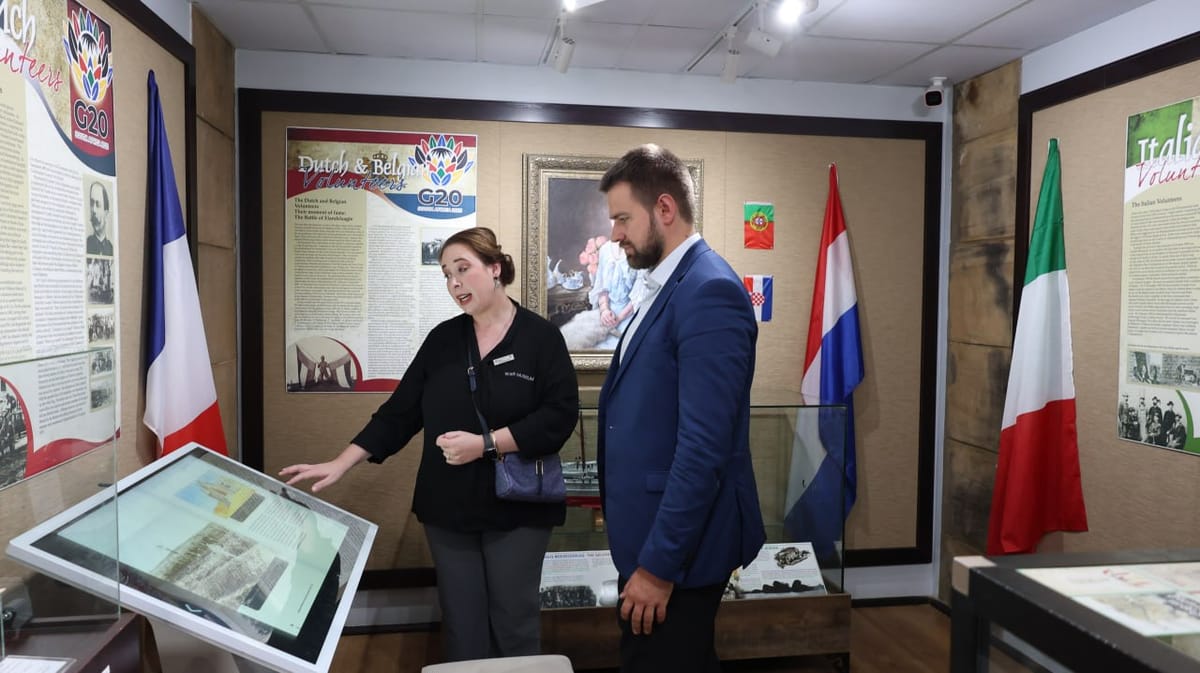
Russia’s Foreign Ministry on Saturday touted a collaboration between the Russian Embassy in South Africa and the War Museum of the Boer Republics in Bloemfontein.
The museum commemorates events from the Second Boer War of 1899 to 1902, when the British Empire fought the two independent Boer republics over control of southern Africa.
The Boers were Dutch-descended settlers in southern Africa who developed a distinct farming society during the 1700s and 1800s. Over time, their descendants spread inland to escape British rule and established their own states, most notably the Orange Free State and the South African Republic.
In the process, the Boers themselves fought wars with African kingdoms and communities and seized large areas of land. These republics later built systems that restricted the rights of Black Africans and relied heavily on coerced or controlled labor.
Sign up for Urgent Matter
If you value clear reporting on how history, diplomacy, and cultural institutions intersect around the world, consider a paid subscription to Urgent Matter.
No spam. Unsubscribe anytime.
After early Boer victories, British forces eventually captured the republics’ capitals and shifted to a harsh counterinsurgency campaign against Boer guerrilla fighters. British troops burned farms, destroyed crops and forced tens of thousands of Boer women and children into concentration camps.
Disease and poor conditions in the camps led to the deaths of more than 26,000 Boer women and children, making the policy one of the most controversial and enduring legacies of the war. Thousands more Black Africans also died in separate camps run by the British.
While Boers later portrayed themselves as victims of British imperial power during the Second Boer War, historians note that these republics also expanded as settler states that displaced Indigenous populations.
The museum was established in 1931 in Bloemfontein, the capital of the former Orange Free State republic, and highlights the suffering of Boer families in British concentration camps.
The Russian Foreign Ministry said in its statement Saturday that the Russian Embassy in South Africa, in collaboration with the museum, is launching a series dedicated to the role of Russian volunteers “who stood alongside the Boers during the Anglo-Boer War.”
“Among the most passionate supporters of the Boer Republics were the people of the Russian Empire, who demonstrated strong solidarity with the Boer cause. During the war, humanitarian initiatives were organized across Russia to send food, clothing, and financial assistance to the Boer Republics,” the Russian Foreign Ministry said.
The Russian Foreign Ministry noted that assistance to the Boers was not limited to diplomacy and humanitarian aid. Around 250 Russian volunteers also travelled to South Africa at their own expense to take part in the fighting, many driven by anti-British sentiment common in Russia at the time.
“Among the most notable volunteers was Yevgeny Maximov, a former Imperial Russian officer who was appointed a combat general by the Boer leadership,” the Russian Foreign Ministry said. “One of Maximov’s most distinguished roles was his command of the Hollander Corps, where he demonstrated exceptional discipline, courage and leadership.”
In a statement in February, the Russian Foreign Ministry said diplomats of the Russian Embassy in South Africa visited the museum to give Russian archival documents, among them an original charcoal portrait of Transvaal President Paul Kruger by artist Petrikovsky.
“We sincerely thank the War Museum in Bloemfontein for preserving the memory of Russian volunteers who stood alongside the Boers during the Anglo-Boer War and for promoting historical truth within South African society,” the Russian Foreign Ministry said.
In December, Russian authorities marked the opening of a new museum in occupied Mariupol with an exhibit dedicated to the “liberation” of the Ukrainian city in 2022.
And in October, Russia’s Victory Museum opened an exhibit dedicated to Moscow’s relationship with Pyongyang that acknowledges North Korea’s involvement in the Ukraine war.
Stories like this take time, documents and a commitment to public transparency. Please support independent arts journalism by subscribing to Urgent Matter and supporting our work directly.