Refik Anadol announced Thursday that his forthcoming museum dedicated to artificial intelligence, DATALAND, would open in Spring 2026 as he released first-look images of what visitors can expect.
The Refik Anadol Studio said in a news release that DATALAND would open inside the Frank Gehry-designed Grand L.A. complex in downtown Los Angeles in the spring but did not specify an exact date. The museum was originally slated to open this year.
The 25,000-square-foot museum will have five distinct gallery spaces, including a reimagined staging of his Infinity Room in Gallery C. The installation is rooted in a design the artist created at the University of California Los Angeles in 2014 as his first immersive data sculpture.

The original Infinity Room, inspired by media architecture and envisioning the future of the Light and Space movement, was envisioned as a 12x12 room with mirrored walls, ceilings and floors and used projectors to display undulating pulses of black-and-white imagery created using AI. It has traveled globally to 35 cities.
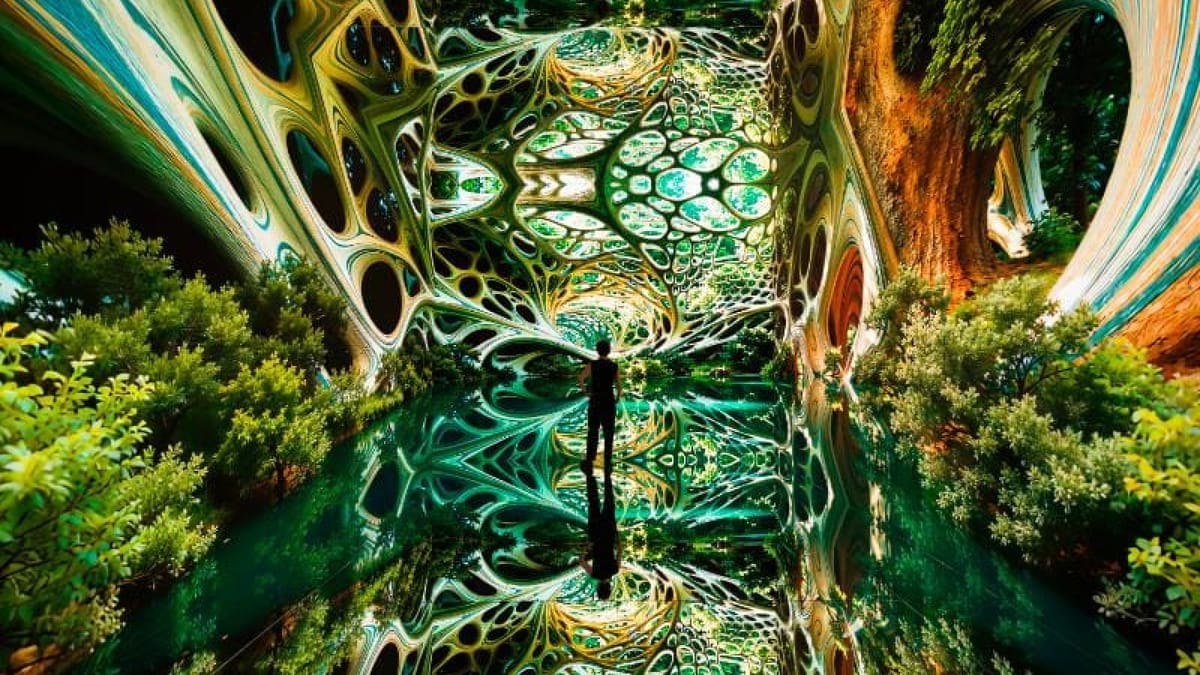
Anadol’s studio released first-look images of DATALAND’s Infinity Room, which was described as “building on the legacy” of the original. The studio said the restaging “reflects the technical, and artistic leaps and bounds” made by his team in the decade since its inception.
The images show a person standing in a mirrored room surrounded by glowing green foliage and reflective surfaces. The walls and ceiling display intricate, lattice-like digital patterns in shades of green and gold, creating an immersive environment.
Anadol’s studio said DATALAND’s Infinity Room will incorporate AI-generated scents from his Large Nature Model. It is also his first immersive space to use an advanced generative AI model that “understands the dynamics of real-world physics and spatial properties.”
“At DATALAND, Infinity Room enters a new era. This iteration embodies the technical and conceptual leaps our studio has made over the past decade,” Anadol wrote in a blog post on his website.
“Where the original used generative algorithms, this new incarnation incorporates our decade-long research into what I call ‘machine hallucinations’ — the dreamlike, surreal realities an AI can generate from vast datasets.”