Québec Biennale uses winter theme to address climate, colonial issues
More than 60 artists across 41 venues in Québec explore climate change and cultural identity through a winter-focused program.

More than 60 artists across 41 venues in Québec explore climate change and cultural identity through a winter-focused program.
Manif d’art, the Québec Biennale, is centering its latest edition on climate change and cultural identity, using its winter setting as a framework for works that engage directly with ice, snow and water.
This year’s theme is “Briser la glace / Splitting Ice.” Manif d’art, marketed as the only winter biennial in North America, is led by curator Didier Morelli, who told Urgent Matter that the theme was inspired by the event’s winter identity.
Manif d’art includes programming at 41 venues in Québec City, Lévis, and other locations across the province, featuring more than 60 artists from 18 countries, organizers said. It runs through April 19.
The central exhibition, held at Espace Quatre Cents, uses a pay-what-you-can ticket system and features works by 17 artists across three floors, organizers said. Other venues include 19 galleries and cultural spaces, four public libraries in Québec City, and 14 temporary public art sites installed for the biennial.
Outside the central exhibition, shows and activities are free for visitors, except for exhibitions at three partner museums—Musée contemporain de Baie-Saint-Paul, Musée d’art de Joliette, and the Huron-Wendat Museum—which charge admission fees.
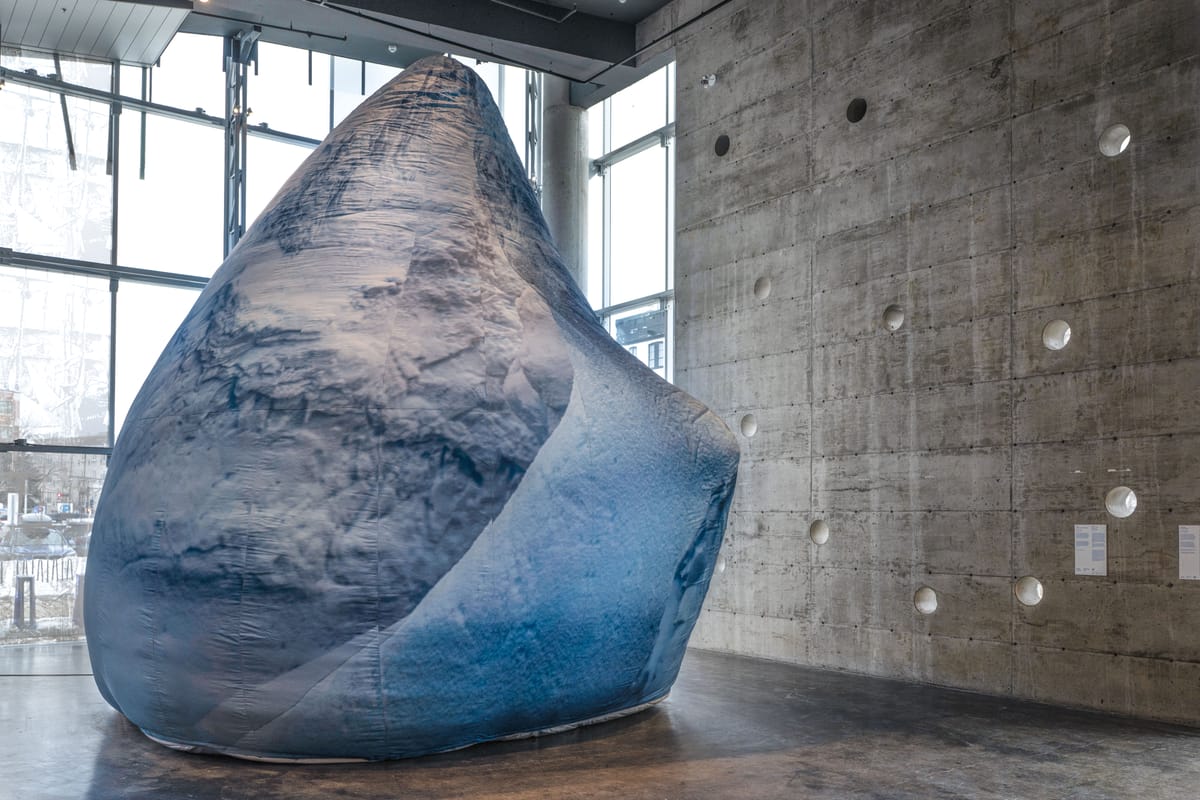
Among highlights from the biennial is a massive three-story inflatable “breathing” iceberg addressing Arctic climate change and coastal vulnerability by artist Jessie Kleemann.
“Kleemann’s work has never been exhibited in North America, so this was an opportunity to show it in a new context, juxtaposed with Québec City’s Winter Carnival which is also filled with constructed winter environments,” Morelli said.
“I hope it will continue to live in the minds of the audience who had the chance to witness it for themselves, to carry the experience of it breathing slowly, like a body illustrating the current climate disaster and the way it affects small communities and island life specifically.”
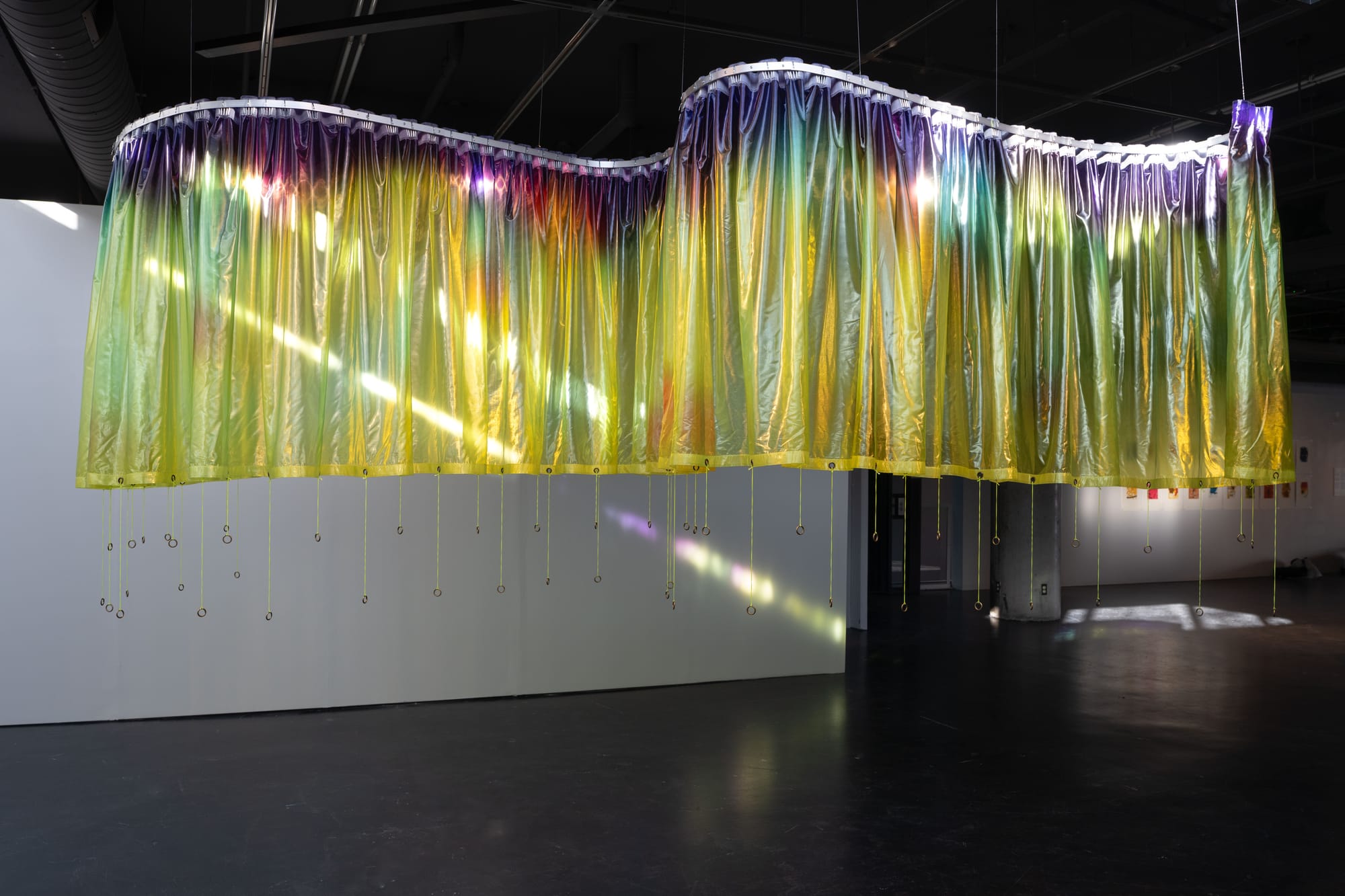
Another notable work is an installation by artist Jota Mombaça, produced by submerging textiles in the St. Lawrence River. The piece evokes “ocean crossings, colonial trade routes and water ecologies.”
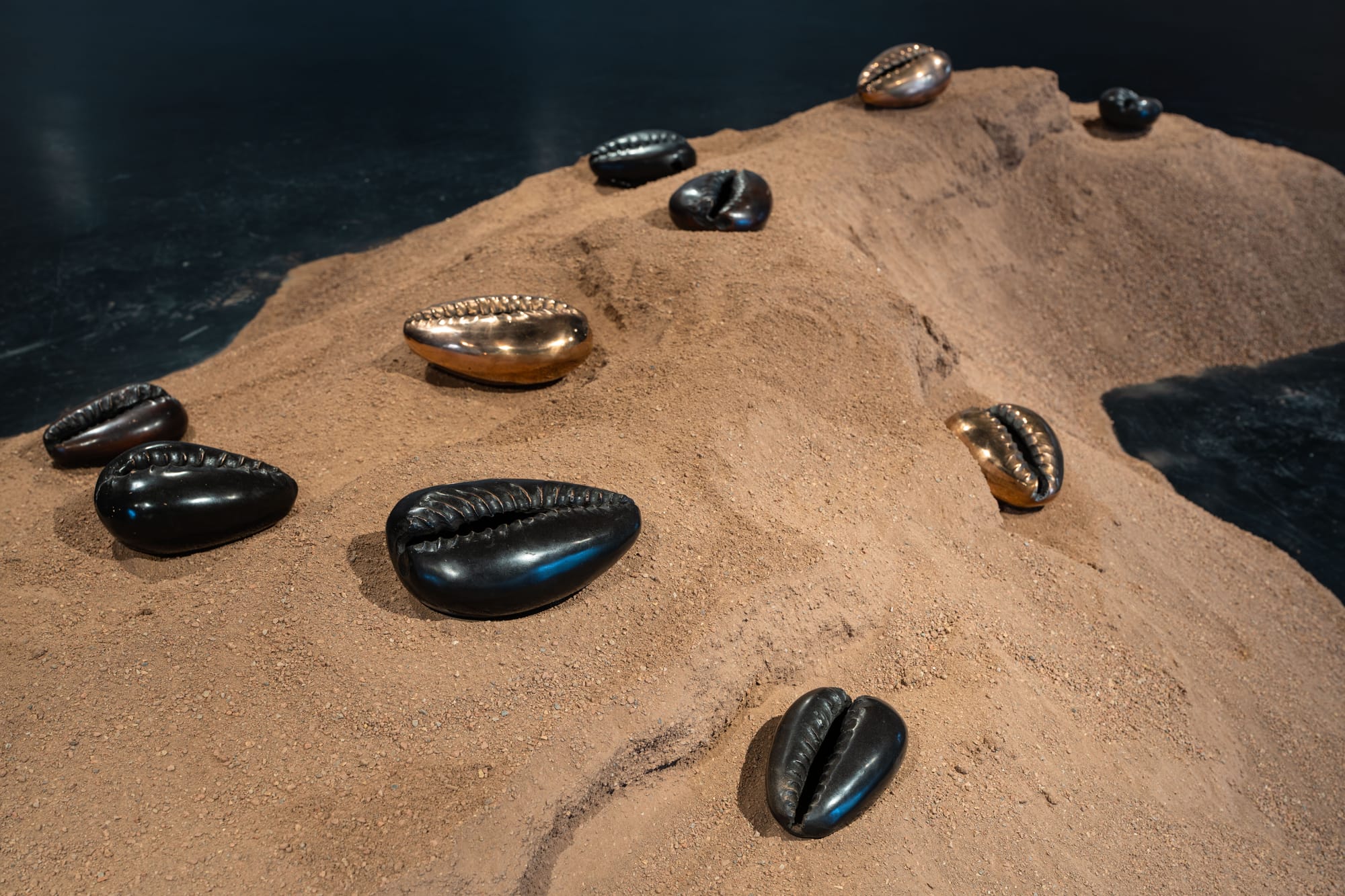
Other highlights include a nearly six-minute video by artist Pia Arke titled Arctic Hysteria, which revisits colonial medical narratives in Greenland, and artist Oluseye’s monumental bronze cowrie shells addressing the histories of Atlantic trade and slavery.
“When I first started working on the exhibition, I wanted to show how, during winter in these regions, we go outside and engage the landscape with our bodies in action, transforming it and in turn being transformed by it,” Morelli said.
The curator said the biennial’s winter setting allows it to address issues from the effects of global warming on communities to colonization and cultural identity, as well as intergenerational histories of women performing in winter landscapes in Québec and beyond.
Morelli was asked how organizers considered their environmental impact as a citywide exhibition at dozens of venues for a biennial focused on climate change. He called it a “careful balance” between local production, presenting existing work, and finding ways to minimize waste.
And, in press materials, Manif d’art described performance as the exhibition’s “curatorial spine.” Morelli said many artists work with found and ready-made materials, reflecting performance traditions that rely on minimal resources.
“At its core, ‘Briser la glace / Splitting Ice’ revolves around a body, a winter or watery landscape, and the actions that occur between these three elements,” Morelli said
“In works like Sylvie Tourangeau’s three performances, where no other material trace exists outside of her intervention, we have the very pure essence of performance, which has very little impact beyond the presence of those who are there to witness it.”
The Tourangeau project was sponsored through a new partnership with the National Gallery of Canada, which organizers said “will significantly advance the institutional recognition of performance art in Canada.”
“Partnerships are critical in bringing new resources to the Biennial but also finding ways of acknowledging practices, and types of practices, that may not have been part of larger institutions,” Morelli told Urgent Matter.
Manif d’art has also forged a new agreement with the Commission de la Capitale Nationale du Québec, which added three new exhibition spaces curated by Dounia Bouzidi and allowed for a “significantly expanded” public art program, according to organizers.
The CCNQ is the provincial government agency responsible for planning, preserving, and promoting Québec City as the capital of the province.
“The commission allows us to feature important emerging curators whose practices are part of the next generation of conversations that are coming on to the contemporary art scene,” Morelli said.
“These spaces, resources, and reaches give us a way to speak about important issues, reach broader audiences, and thankfully they have not been weary of the critical angles we have taken that do not shy away from pointing out the contradictions and lack of accountability of the governments.”
The curator said the biennial includes artists from a 102-year-old artist Françoise Sullivan to those in their 20s, aiming to connect historical work with contemporary practices and show how ideas carry across generations.
“Having an intergenerational perspective was important because knowledge, culture, and relationships to water, ice, and snow are passed on through the body in action,” Morelli said.
“There are many matriarchs of performance in the exhibition, paving the way for future generations to make interdisciplinary work that is deeply embodied, aesthetically meaningful, and socially grounded.”
Organizers noted that 35% of the works in the biennial are new commissions, reflecting a focus on new production.
“We are in a really special position in Québec City where these works that are new commissions can all be made here, by local producers and in the artist-run-centers that are presenting them,” Morelli said.
“Giving artists like Jota Mombaça, Anchi Lin, Elias Nafaa, or Anouk Vervier for example, the opportunity to either push a body of work further, or create an entirely new one, within the security of a supportive and committed community of cultural workers is really unique and important.”
Stories like this take time, documents and a commitment to public transparency. Please support independent arts journalism by subscribing to Urgent Matter and supporting our work directly.