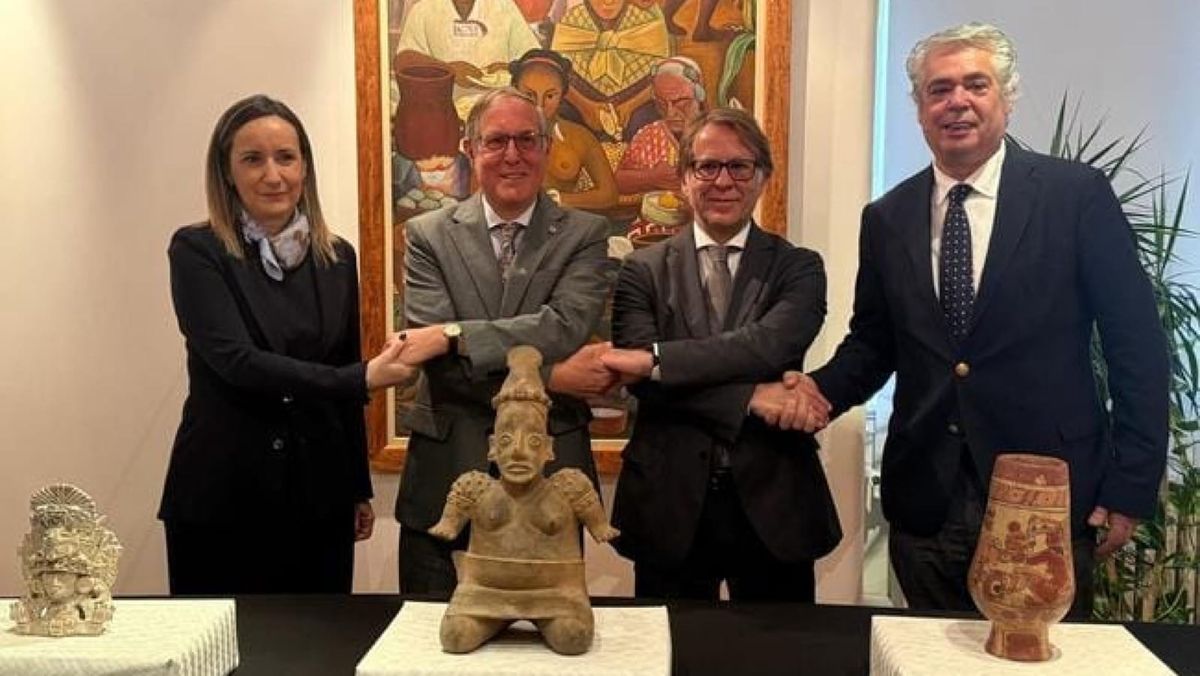
Four officials shake hands behind three pre-Hispanic artifacts displayed on tables during a restitution ceremony at the Mexican Embassy in Lisbon. Photo courtesy of Mexico's Culture Ministry
Portugal has carried out its first restitution of artifacts to Mexico, according to Mexico’s Culture Ministry, after Portuguese authorities last year requested that the seized items be examined.
Portuguese authorities had notified the Mexican Embassy in Lisbon that three archaeological artifacts unlawfully taken from Mexico were identified and recovered by Portugal’s Judicial Police and the Camões Institute for Cooperation and Language, Mexican officials said in a statement last week.
Specialists from Mexico’s National Institute of Anthropology and History then conducted a preliminary review of the three artifacts, based on images provided by local authorities.
At Portugal’s request, Mexican archaeologist Aline Lara Galicia, a member of a research group at the University of Seville, then examined the artifacts in person and confirmed their authenticity and cultural importance.
The restitution ceremony took place at the Mexican Embassy on February 12. The items will be sent to Mexico in a diplomatic pouch in coming weeks.
“This return confirms that international cooperation protects who we are,” Mexican Secretary of Culture Claudia Curiel de Icaza said.
“Each restitution restores memory and identity to Mexico and reaffirms the shared commitment to combating the trafficking of cultural property.”
The artifacts include a clay female figure from what is now the state of Jalisco, a Maya polychrome vessel, and a Zapotec funerary urn. Public prosecutors in Lisbon investigated the case that led to the seizure of the clay figure, while prosecutors in Guimarães handled the polychrome vessel and those in Évora-Estremoz investigated the urn.
The clay figure, sold at auction in 2024, is associated with fertility and maternity rituals. It measures about 17 inches tall and depicts a bare-chested woman on her knees with a skirt and a conical headdress. It was made between 300 and 600 CE in the Tala-Tonalá style of the Shaft Tomb cultural tradition.
The polychrome vessel, which most likely originated in southeastern Mexico, dates to between 600 and 900 CE, Mexico’s Culture Ministry said. It is decorated with scenes of elite figures and glyphs and may have been used for the ritual consumption of beverages such as cacao.
Prosecutors said the funerary urn originated from the Oaxaca region and depicts Cocijo, the Zapotec deity of rain and thunder. It dates to between 600 and 1200 CE.
Stories like this take time, documents and a commitment to public transparency. Please support independent arts journalism by subscribing to Urgent Matter and supporting our work directly.“
Share this article
The link has been copied!
Members Discussion
Your link has expired. Please request a new one.
Your link has expired. Please request a new one.
Your link has expired. Please request a new one.
Great! You've successfully signed up.
Great! You've successfully signed up.
Welcome back! You've successfully signed in.
Success! You now have access to additional content.