Planet Labs, a major commercial satellite imagery provider, said it would indefinitely withhold images of Iran and the wider conflict zone at the request of the U.S. government.
The company’s satellite imagery is used by news organizations and researchers to independently assess damage in areas where on-the-ground access is limited—a shift that may significantly hinder efforts to verify damage to Iranian cultural sites.
Planet Labs said in an email to customers that, instead of broadly releasing its imagery, it would move to a “managed distribution” model in which material deemed not to pose a risk to safety would be released on a case-by-case basis for urgent, mission-critical requirements or in the public interest, Reuters reported.
The decision expands on a policy announced last month in which it had already delayed release of imagery from the Middle East by 14 days, according to the report. The company said all imagery since March 9 would be affected and that it expects the policy to remain indefinitely through the end of the war.
Sign up for Urgent Matter
As access to imagery tightens, so does what can be independently verified. Sign up for a paid subscription to Urgent Matter to support reporting that pushes past those limits.
No spam. Unsubscribe anytime.
Planet Labs said the move followed a request from the U.S. government tied to concerns that opposing forces could use commercial imagery to attack American and allied forces. More targeted measures, such as restricting imagery of active military locations, could address those concerns without broadly limiting access to imagery of civilian and cultural sites.
Urgent Matter sought access to satellite imagery from Planet Labs and other companies. On March 9, we emailed seeking access to imagery for several Iranian cultural heritage locations, including Golestan Palace and Naqsh-e Jahan Square—both UNESCO World Heritage sites.
That email was sent the same day as the March 9 cutoff now applied to imagery no longer broadly released under Planet’s new policy. We did not receive a response.
The decision restricts one of the few independent tools available to verify what has been hit, how badly, and what may be missing from official accounts—particularly when reporting on damage to cultural sites.
This especially matters in Iran, where access is constrained and the country is facing an extended internet blackout. As of April 5, the shutdown had entered its 37th consecutive day, or 864 hours, and NetBlocks said it was the “longest nation-scale internet shutdown on record in any country.”
The result is a double blind: with domestic internet access curtailed and commercial satellite imagery no longer broadly released, both on-the-ground reporting and independent verification are limited at the same time.
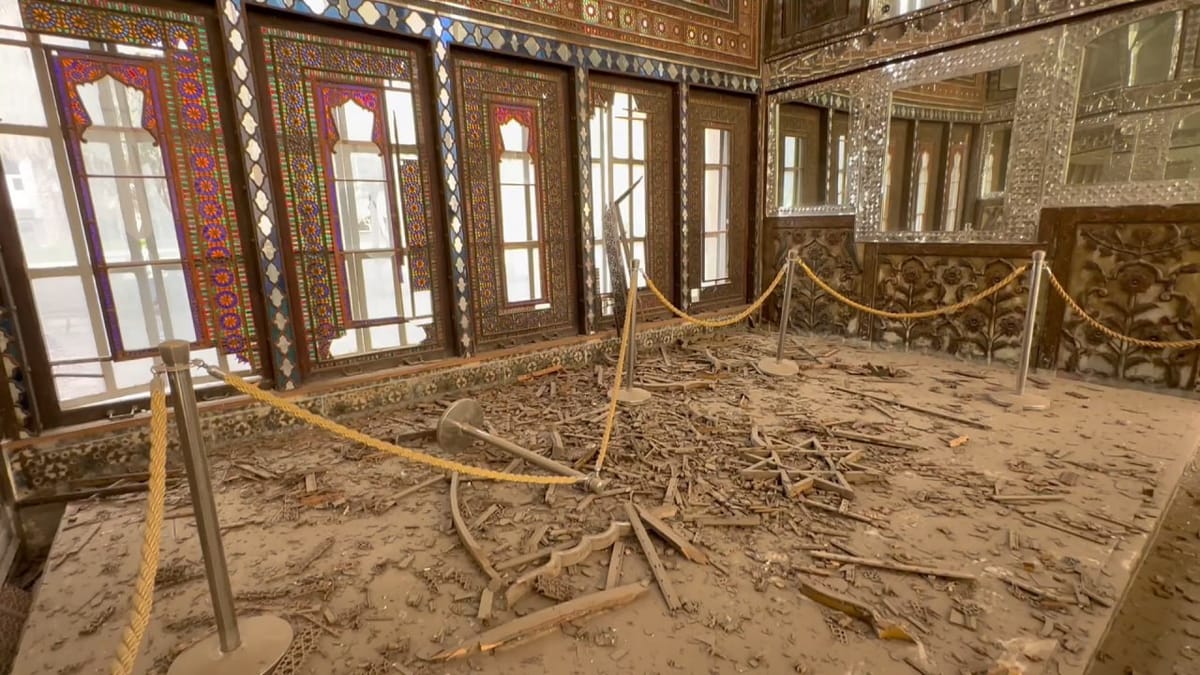
As a result, reporting on damage to cultural sites has largely relied on statements and images from Iran’s Ministry of Cultural Heritage, Tourism and Handicrafts—with some confirmation from UNESCO and Iranian-affiliated media.
Relying on the Iranian government for such disclosures raises concerns from critics of the Iranian government of propaganda while the lack of independent imagery also allows for denialism. Without satellite proof, striking forces can claim there was no collateral damage.
Urgent Matter reported in mid-March that Iranian authorities had documented damage to 56 cultural sites in Iran but had not yet provided a full list of the sites damaged—adding to the difficulty in verifying and reporting on such damage.
While images released by Iranian authorities for publicized sites show some of the destruction caused by strikes and blast waves, satellite imagery can help establish when and how sites were impacted and provide independent documentation of the damage.
Urgent Matter calls on Planet Labs, the U.S. government and all satellite imagery providers to ensure that journalists and researchers can obtain timely access to satellite imagery from Iran to document damage to cultural sites.