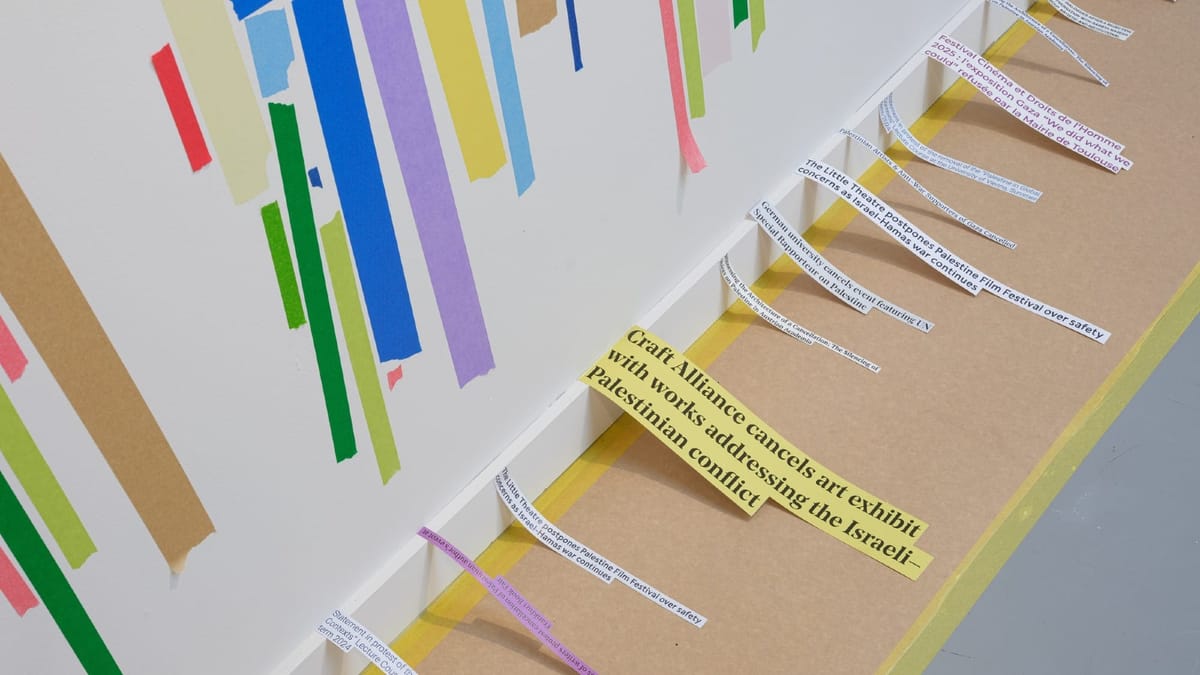
Walid Raad (met - with Pierre Huyghebaert) - I thought I’d escape my fate (again) - detail, 2026. Foto Christine Clinckx - M HKA
An exhibition making its European debut in Belgium centers on Palestinian artists, bringing together works that examine censorship, exile and political repression in the contemporary art world.
The exhibition, titled “we refuse_d,” opened Friday at M HKA, the Museum of Contemporary Art Antwerp. It was first organized by Mathaf: Arab Museum of Modern Art in Doha.
Its European debut comes as Qatar, which helped organize the exhibition and often served as a mediator in ceasefire negotiations between Hamas and Israel, is navigating ongoing Iranian missile strikes after joint U.S. and Israeli strikes on Iran triggered Tehran’s retaliation across the Gulf.
Curated by Nadia Radwan and Vasıf Kortun, the exhibition features works by 15 artists whose practices address censorship, displacement and the politics of cultural expression.
Organizers said the project was conceived amid what they described as growing pressure on artists and academics whose work addresses Palestine.
“Since the start of the genocide in Palestine, this pressure has intensified significantly,” the exhibition materials state. “Voices are silenced, exhibitions are cancelled and works end up unseen in archives.”
Many of the participating artists are Palestinian or work within contexts shaped by diaspora and exile. The exhibition includes works by Emily Jacir, Jumana Manna, Khalil Rabah and Taysir Batniji, alongside artists including Walid Raad and the collective Decolonizing Architecture Art Research, or DAAR.
The exhibition takes its title from the nineteenth-century Salon des Refusés in Paris, which displayed works rejected by the official Salon, as well as from Hannah Arendt’s 1943 essay We Refugees, which explored displacement and resilience among people forced into exile.
Several works in the exhibition address Palestinian history and the political realities of occupation and displacement. Batniji, born in Gaza and now living in exile in France, presents works centered on house keys, objects that have become symbols of memory and loss for displaced families.
Other installations examine how censorship operates within cultural institutions and political systems. A work by Manna includes handmade flags with quotations from Palestinian political prisoners, while her film Foragers explores how Israeli conservation laws affect the traditional Palestinian practice of gathering wild plants.
The Antwerp presentation also includes a broader public program tied to the exhibition. Among the events is a traveling installation titled Nomadic Monument for Gaza, which organizers say aims to commemorate victims of the war and create space for discussion of Palestinian culture, resilience and solidarity.
The show runs through June 7.
Stories like this take time, documents and a commitment to public transparency. Please support independent arts journalism by subscribing to Urgent Matter and supporting our work directly.
Share this article
The link has been copied!
Members Discussion
Your link has expired. Please request a new one.
Your link has expired. Please request a new one.
Your link has expired. Please request a new one.
Great! You've successfully signed up.
Great! You've successfully signed up.
Welcome back! You've successfully signed in.
Success! You now have access to additional content.