NYSWA's ‘Courting Challenges’ exhibit brings social justice themes to federal court
Work by the New York Society of Women Artists ranges from abstract painting to figurative sculpture and pieces made with found materials.

Work by the New York Society of Women Artists ranges from abstract painting to figurative sculpture and pieces made with found materials.
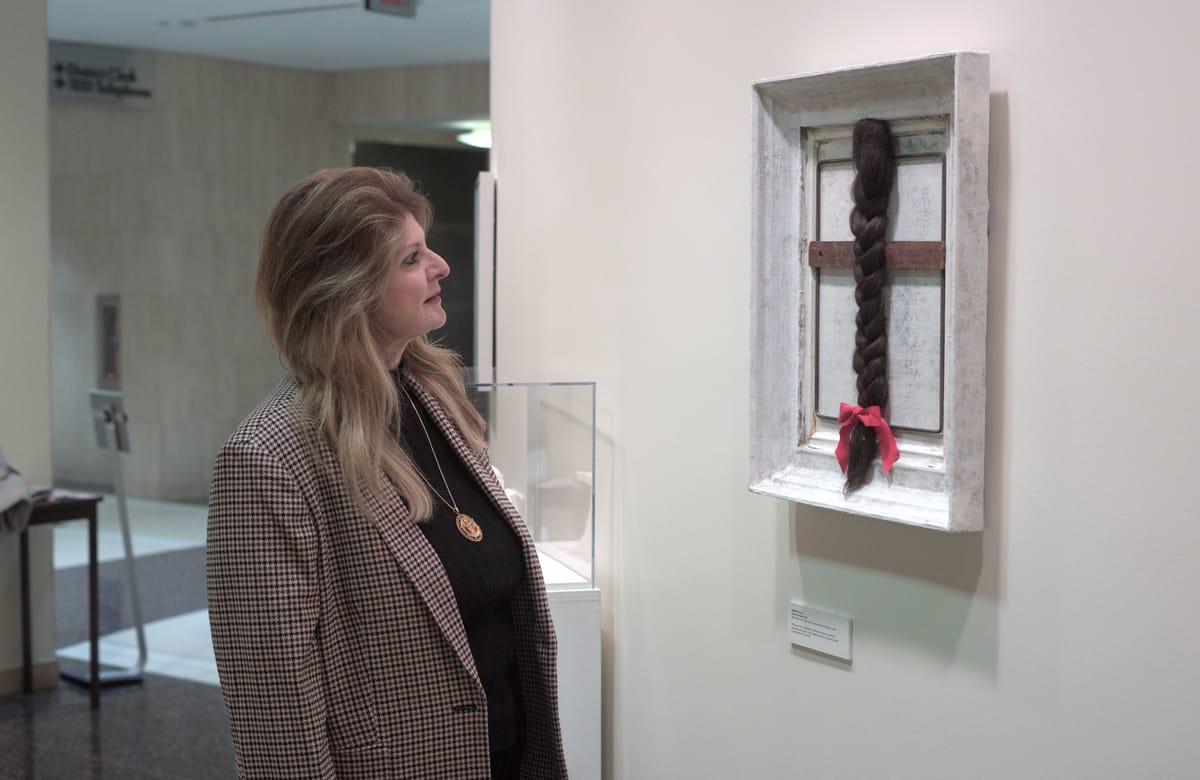
Brooklyn federal court is hosting an exhibit by the New York Society of Women Artists that addresses themes like climate change, social justice and human rights. The exhibit is open to the public—after guests pass through security.
“It’s peaceful and optimistic,” said Celia Wells. She visited the courthouse with a companion, Monika, who described the exhibit as a “therapeutic” way to pass time that “sets a good tone.”
The exhibit, titled “Reflections on Progress: Courting Challenges,” is on view in the Charles P. Sifton Gallery, dedicated to the late chief judge who presided over major cases, including rulings that led to the approval of the abortion pill mifepristone in the United States and to women joining the New York Fire Department.
Since its dedication in 2010, the gallery's curators have included Sifton, Judge Raymond J. Dearie, and current curator Judge Robert M. Levy. The rotating curator judge has final approval of artworks that go on view.
“Everything that we did here has to be approved,” Lori Horowitz, president of the NYSWA, said. “Are the pieces appropriate? Are the statements appropriate? Can they be shown here without being dangerous, too pointy, whatever it would be?”
She noted that the exhibit was originally scheduled for November 2025 but was delayed due to the government shutdown. “We didn't know if this was even going to happen,” Horowitz said. “We didn't know what the funding would be.”
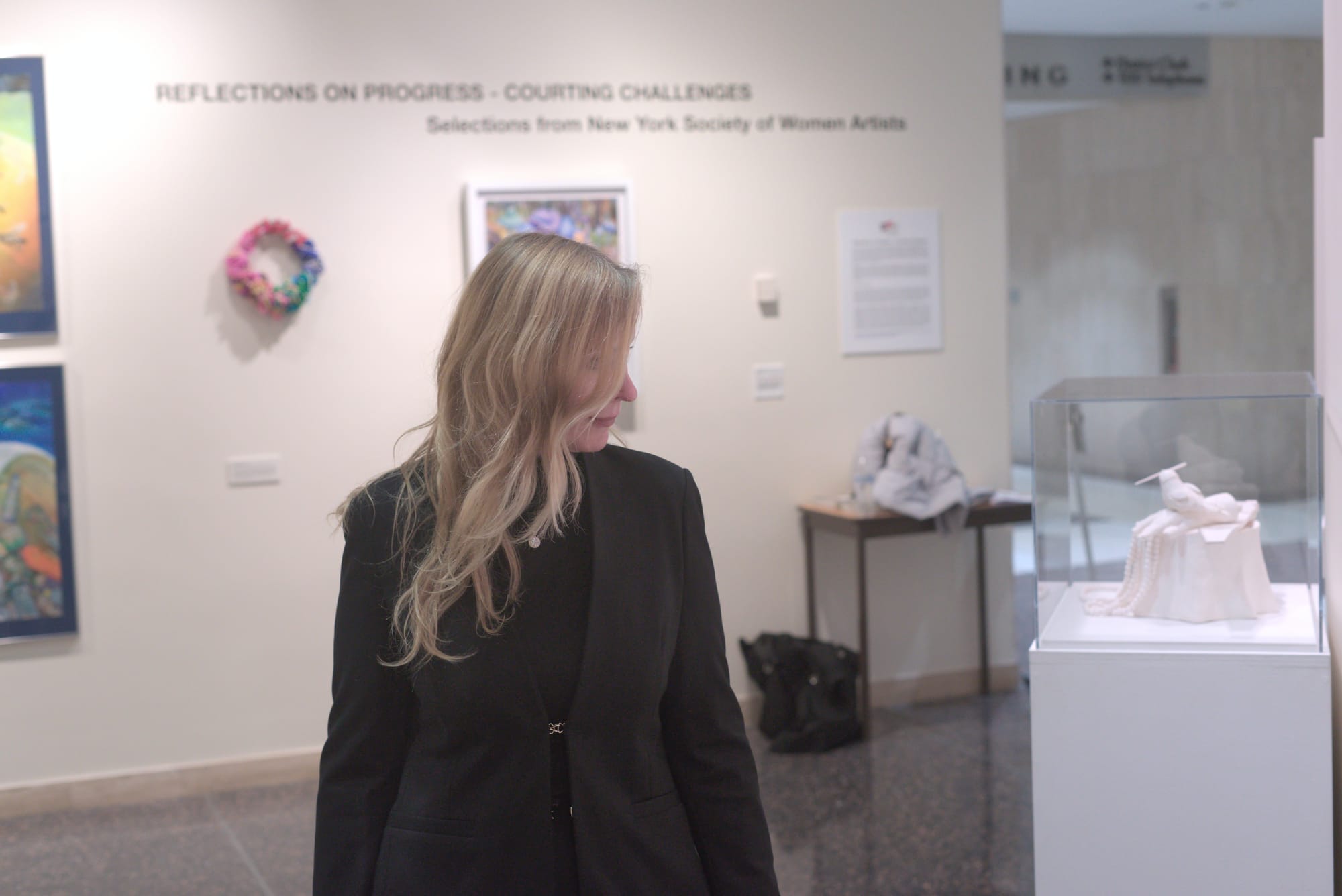
In January, Horowitz said she reached out to the courts again and was told the exhibit could move forward as the courts reopened.
The process also limited the organization to including only smaller works, though participants typically make work that is substantially larger, Horowitz said.
She noted that no works were excluded for safety reasons, crediting the organization's planning. One artist, Pam J. Brown, typically creates sharp objects. For this exhibit, Brown included a sculpture of a tree stump and saw made from polymer clay, which is the only piece displayed under glass.
“Civic engagement has long been a goal of this court. The Sifton Gallery is one way the court works to contribute to the life of our community by supporting and promoting the cultural life of its residents,” Levy said to Urgent Matter.
Horowitz said that the exhibition comes after the society marked its centennial last year. The organization was founded in 1925 by 23 painters and sculptors in the wake of the suffragist movement and aimed to support women artists in a largely male profession.
Artists seeking membership in the society must submit applications, which are evaluated by a jury panel of five judges in what Horowitz described as a “very stringent process.” Candidates are assessed not only on the quality of their artistic practice but also on their potential for active participation. Once selected, members retain their status for life.
“Although we are not solely a political group, it's important we address the challenges that we're facing in society, in the environment, and culturally,” Horowitz said. “We're in a very contentious time right now, with everything that's going on.”
She said that, with the exhibit shown in a federal courthouse, the work had to be presented in a way that stayed “somewhat neutral”—likening any political messaging to a journalist “stating the facts.”
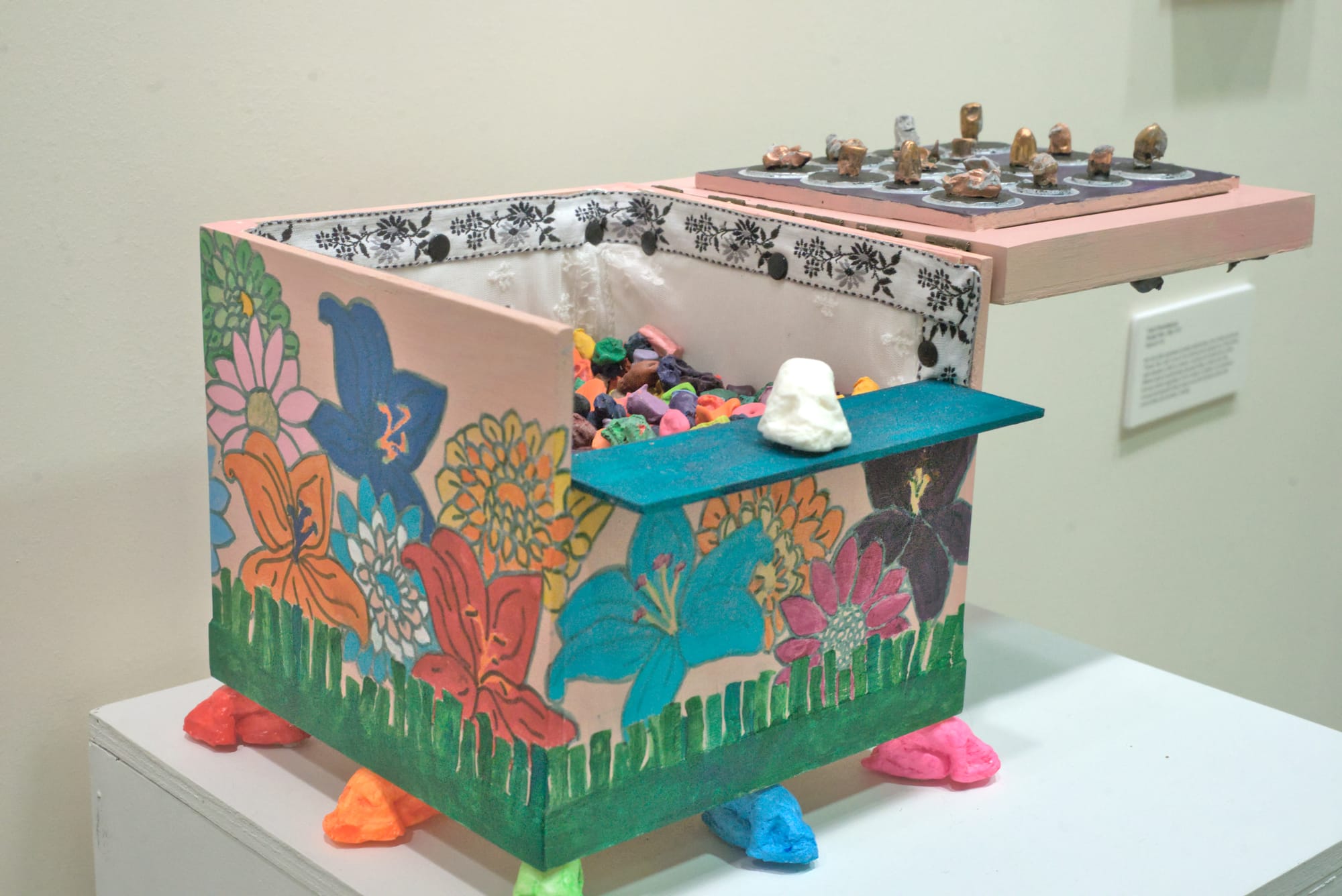
Artist Anna Kuchel Rabinowitz is showing the sculptural work 1412 Thoughts and Prayers, created to honor the children killed by gun violence in the United States in 2024. That work utilizes crayons donated by a New York City preschool that were cast into bullet fragments.
“Again, you know, although we're supposed to stay neutral, we're being neutral stating the facts. That's the facts,” Horowitz said. “It's basically showing the bullets, the crayons. It's saying, ‘This is what happened.’ It doesn't say anything other than that.”
Lauren Gohara created a painting titled She’s in the Money: The Richest Women in the World v.20230419, which at first appears to be an abstract grid of 100 geometric circles.
Twelve of the circles represent the women who were among the world’s wealthiest people in 2023, with their colors taken from the logos of the companies that were the source of their wealth, and their position determined by their rank on Forbes’ list of billionaires.
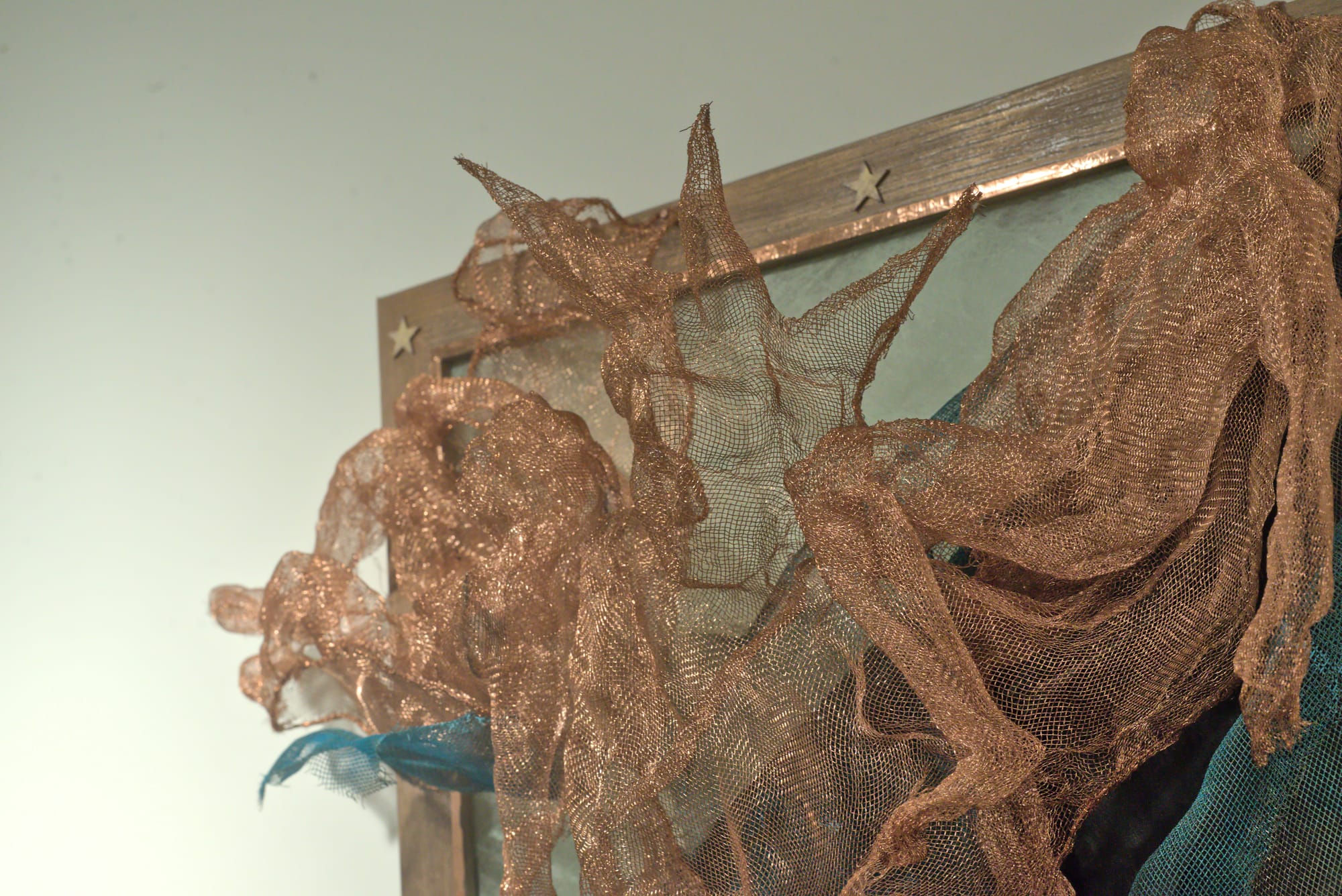
Horowitz contributed two works to the show. One, titled Balance of Liberty, is a copper-wire maquette for a larger sculpture depicting four figures clinging to and being trampled by a towering figure inspired by the Statue of Liberty.
“Are we supporting or are we sort of stepping over our rights as people?” Horowitz said in describing her work.
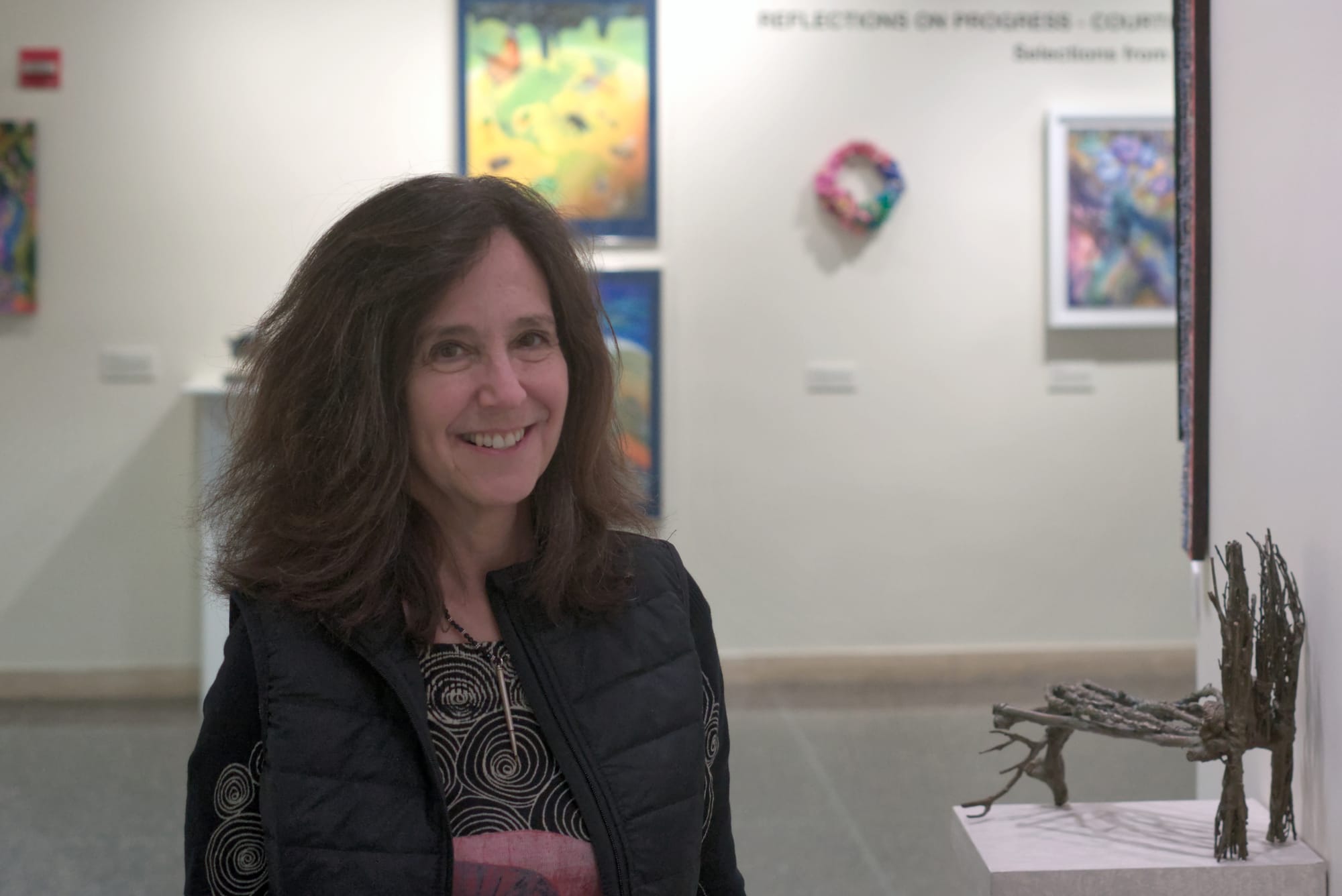
One bronze sculpture, a bed of twigs created by artist Leah Poller, pokes fun at the challenges of the legal justice system—primarily through the humorous play on words of its title, Lit-tige.
In French, “lit-tige” translates to “bed of twigs,” while “litige” is a court proceeding. Poller said the work is meant to illustrate “the many twists and turns of legal proceedings, the branches of the law, with a delicate balance as the outcome.”
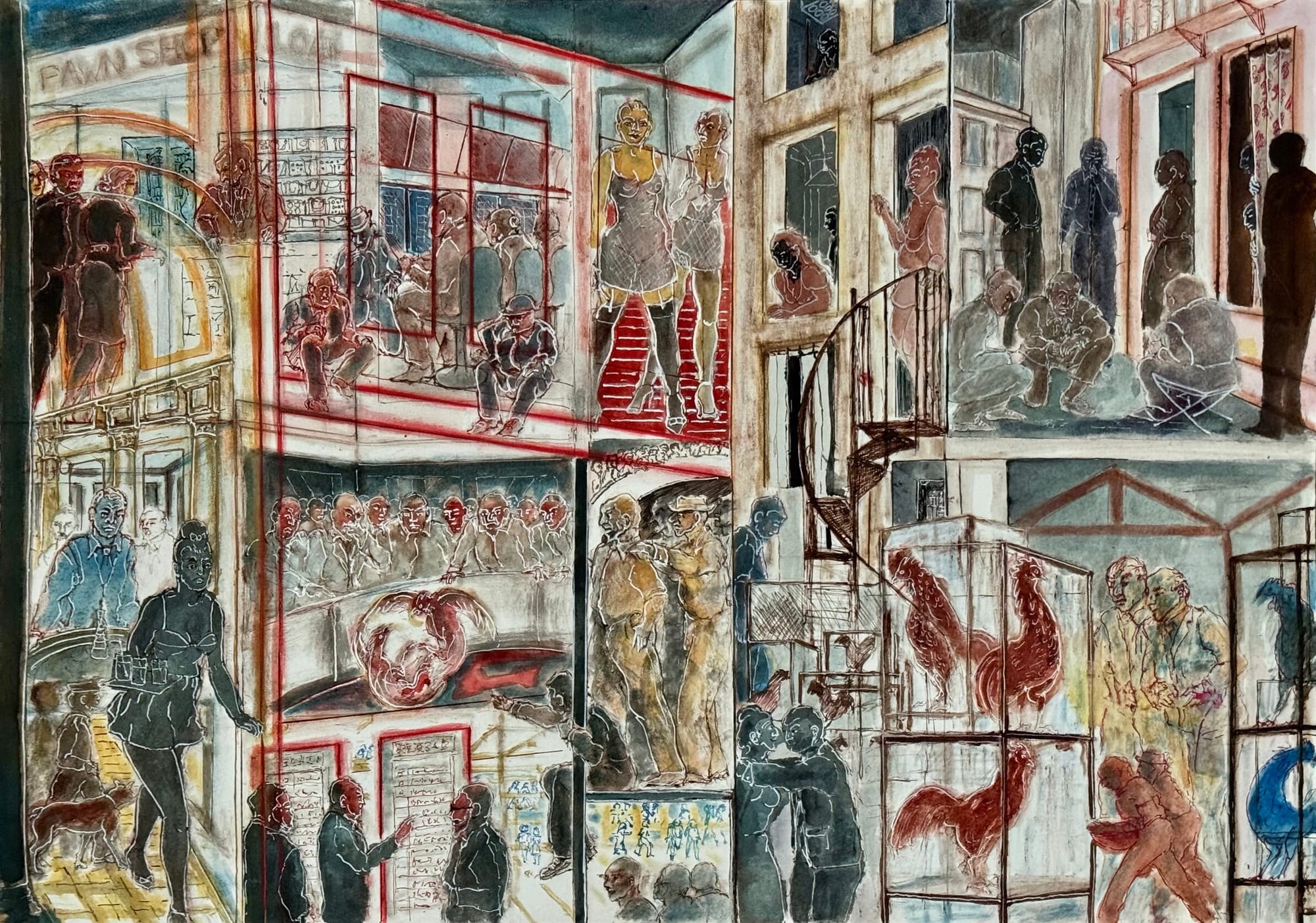
Siena Gillann Porta has included a painting of two women sparring during an international Kimura Shukokai Karate competition, which the artist said marks a cultural shift toward recognizing women in spaces once reserved solely for men.
Not all the works in the show have such clear, even if subtle, sociopolitical messaging.
Two works by nonagenarian Julia Rogge depict musicians playing jazz in Central Park. The wall text for her work said, “Rogge views Central Park as a vast playground where people coexist with nature.”
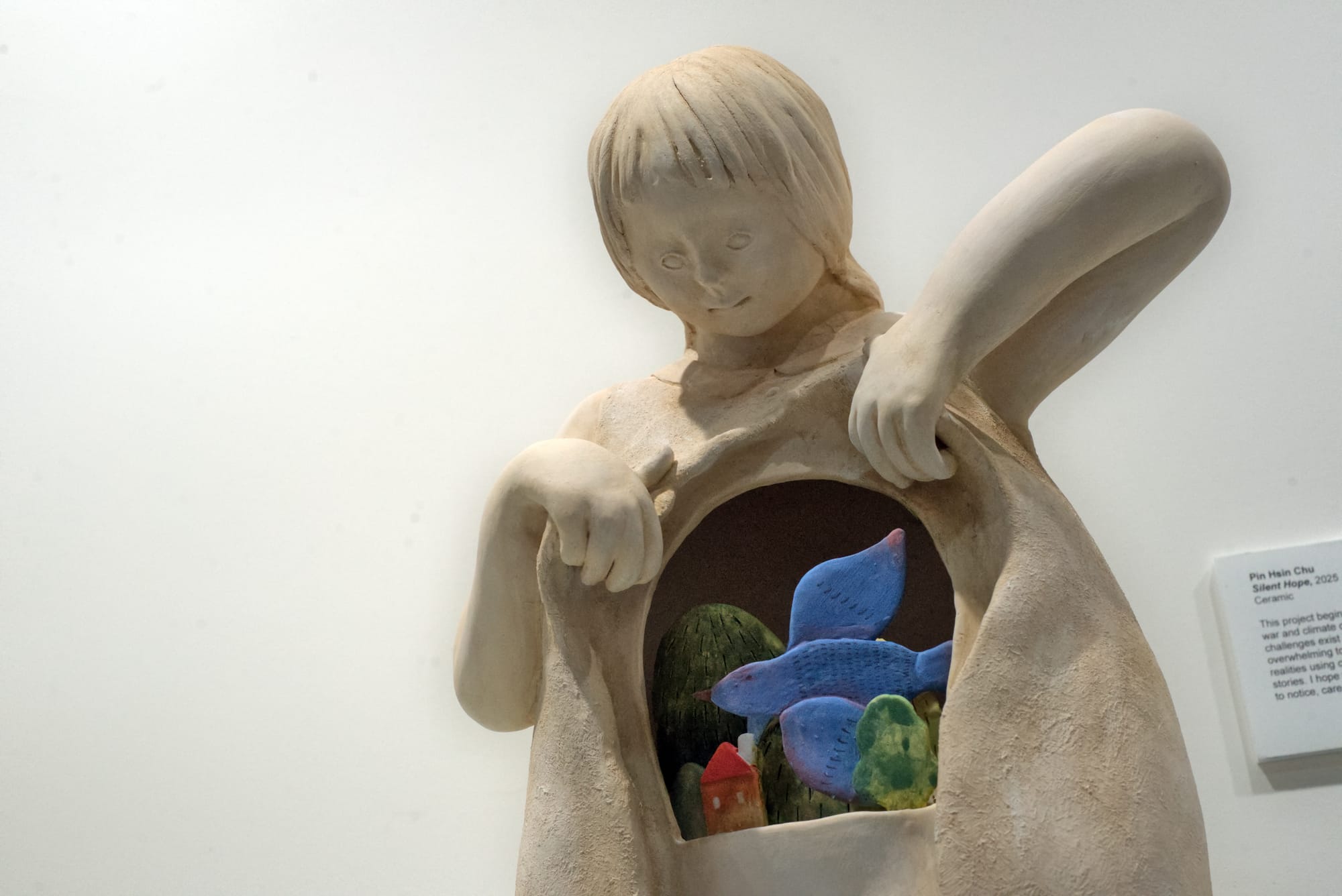
And works by the NYSWA’s youngest member, 19-year-old Pin Hsin Chu, are storybook-like clay sculptures of children. Reading the wall text gives them a deeper connection to the theme.
Chu wrote of her work Silent Hope that the project began with a focus on global issues affecting children, from war and climate change to health, nutrition and living conditions.
“These challenges exist everywhere, yet they are often overlooked or feel too overwhelming to face,” Chu said. “Through my ceramic works, I interpret these realities using clay as a quiet but expressive medium to tell children’s stories. I hope viewers feel a sense of beauty and peace and are moved to notice, care and reflect.”
While the artists' ages span more than seven decades, Horowitz said the median or average age of participants is in the late 50s or early 60s.
“I've been president for the last full year, and it's my goal to really make this a very progressive and really have voices and the concerns of women artists, all artists, heard,” Horowitz said.
While the society has historically not included photography, and still doesn’t, Horowitz said the organization may move toward allowing it as a medium. In fact, one of the most direct commentaries in the show is a photograph by artist Rose Deler.
That photograph, titled supreme court: no caps, was created in 2022—the year the U.S. Supreme Court overturned the landmark case of Roe v. Wade.
The black-and-white photograph depicts a sculpture by Deler. The sculpture, which appears monumental in the photograph, depicts a woman’s dress on a coat hanger, with several other coat hangers visible through the sheer fabric.
“Normally, this wouldn't have been in a show, because it's photographed. So, I personally have no problem with it. And she does a lot of very feminist work having to do with women's symbolism. A lot of sewing, corsets, hangers. It's all about that,” Horowitz said, pausing for a while. “And abortion.”
After making that reflection, Horowitz expressed some discomfort, considering the politically neutral location of the courthouse—though the intention of the work is clear by its construction and wall text.
“Look, when Roe v. Wade was overturned, everyone made pieces. I shouldn't say everyone, but a good number of us made pieces representing our feelings and thoughts about it,” she said. “And they were pretty strong.”
Stories like this take time, documents and a commitment to public transparency. Please support independent arts journalism by subscribing to Urgent Matter and supporting our work directly.