Nobel medals have been sold at auction, donated to institutions, used to pay medical bills, and given away for political reasons.
The institution that awards the Nobel Peace Prize said in a statement Friday that the honor itself does not move with the recipient.
“The medal and the diploma are the physical symbols confirming that an individual or organization has been awarded the Nobel Peace Prize,” the Norwegian Nobel Committee said.
“The prize itself – the honor and recognition – remains inseparably linked to the person or organization designated as the laureate by the Norwegian Nobel Committee.”
The designation, it added, is final and applies “for all time.”
Although the committee stressed that the award is permanent, it also said there are no rules about what winners can do with the medal and diploma they receive.
Under the statutes of the Nobel Foundation, laureates are free to keep, sell, donate, or otherwise dispose of the medal and diploma, and to use the prize money as they choose.
As a result, Nobel medals have taken widely different paths after their presentation.
Dmitry Muratov, a Russian journalist who shared the 2021 Nobel Peace Prize, sold his medal at auction for $103.5 million the following year and donated the proceeds to UNICEF to help Ukrainian refugee children.
Some medals have been sold for personal reasons. Leon Lederman, who won the Nobel Prize in Physics in 1988, sold his medal in 2015 to help cover medical costs for dementia, according to the committee.
James Watson, who shared the 1962 Nobel Prize in Medicine, sold his medal in 2014 and used some of the money to support research. Later, Russian businessman Alisher Usmanov bought the medal and gave it back to Watson.
Some medals have become part of public collections. Kofi Annan’s medal and diploma from his 2001 Peace Prize were donated last year by his widow, Nane Annan, to the United Nations Office in Geneva, where they are now on display. Norway’s first Nobel Peace Prize medal, given in 1921 to Christian Lous Lange, has been on loan to the Nobel Peace Center in Oslo since 2005.
Knut Hamsun, who won the Nobel Prize in Literature in 1920, sent his medal in 1943 to Nazi propaganda minister Joseph Goebbels after meeting him in Germany. The committee said the medal’s current location is unknown.
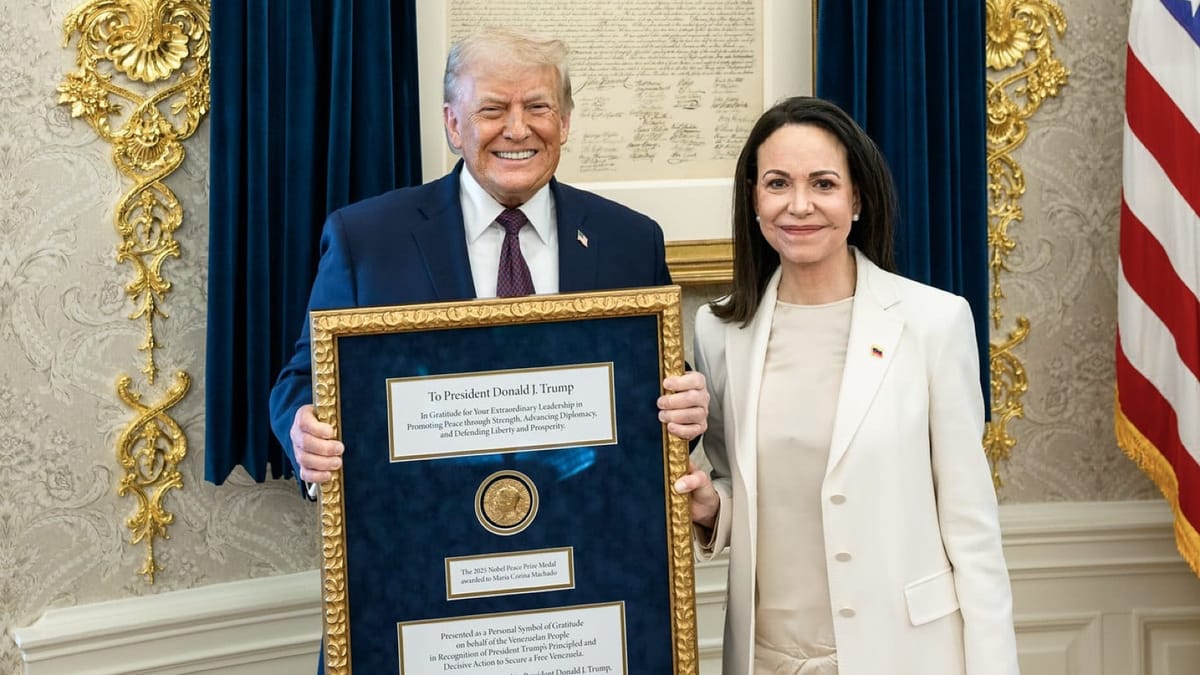
The Norwegian Nobel Committee’s clarification comes after recent events involving President Donald Trump and María Corina Machado, the Venezuelan opposition leader named the 2025 Nobel Peace Prize winner. The committee’s statement did not mention Trump or Machado by name.
Machado visited the White House on Thursday to publicly present her Nobel medal to Trump, praising his role in developments related to Venezuela’s political crisis, including the surprise removal of former Venezuelan President Nicolas Maduro.
Trump, who has long jockeyed for the Nobel Peace Prize, accepted the medal from Machado. Many see Machado’s gift as an attempt to gain the president’s support for her to lead her country, though Venezuelan officials have installed Delcy Rodríguez, the former Vice President, as interim president.
During her White House visit, Machado compared her gesture to historical symbolic gifts, such as the Marquis de Lafayette presenting medals to Simón Bolívar — a comparison she used to frame the act as a bond between the United States and Venezuela’s opposition movement.
But some Norwegian scholars and politicians criticized the transfer, saying it risked diminishing the prestige of the Nobel Peace Prize.
The episode has exposed the fragility of symbolic authority in an era when honors are passed around beyond the institutions that confer them.
The Norwegian Nobel Committee said it does not comment on laureates' later actions or political decisions, nor does it reassess awards after they are made. The prize, it said, is granted based on a laureate’s contributions at the time of the decision.
“The Committee does not comment on laureates’ subsequent statements, decisions, or actions,” it said. “Any ongoing assessments or choices made by laureates must be understood as their own responsibility.”
Stories like this take time, documents and a commitment to public transparency. Please support independent arts journalism by subscribing to Urgent Matter and supporting our work directly.