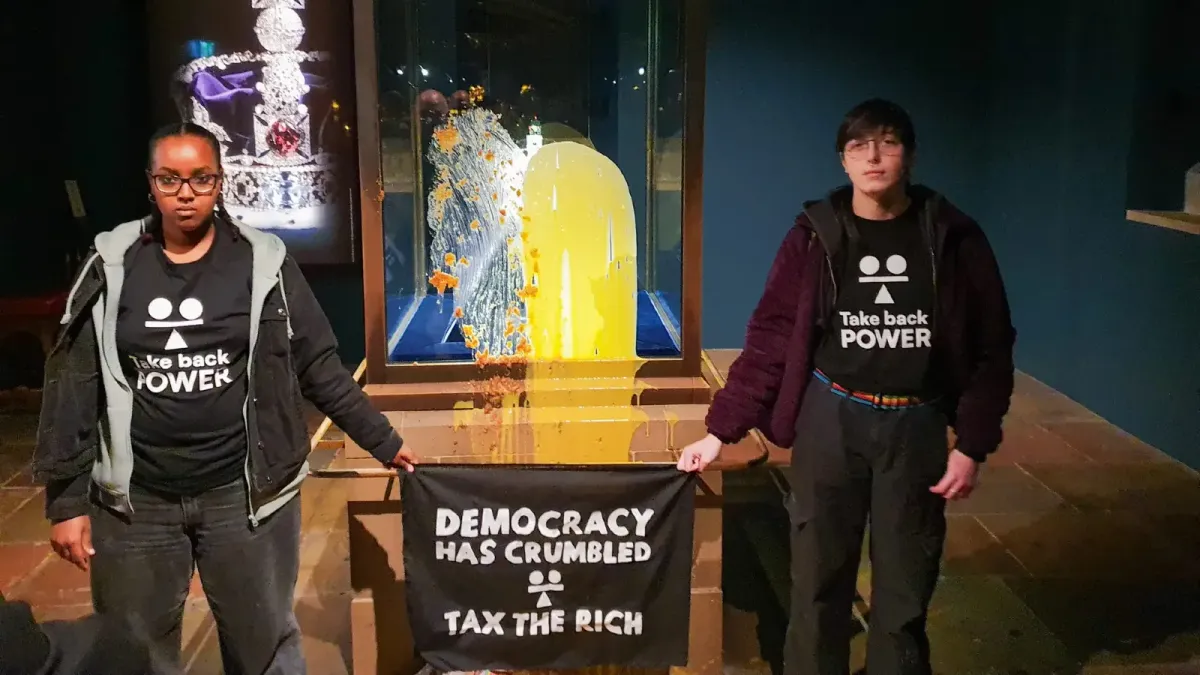
British police arrested four protesters Saturday after they threw apple crumble and custard at the protective case surrounding the Imperial State Crown at the Tower of London.
Take Back Power, a group that may be inspired by or adjacent to the Just Stop Oil network, though no direct relationship has been confirmed, held a banner that “democracy has crumbled” before being taken into custody on suspicion of criminal damage, UPI reported.
They have also released a manifesto calling for the taxation of Britain’s ultra-wealthy and have asked for donations to support their legal costs.
The déjà vu of the theatrical gesture cannot be ignored, with Take Back Power’s website and news release reading strikingly similar in tone and structure to Just Stop Oil’s communications.
But the action also signaled something consequential—a strategic pivot in the landscape of civil resistance.
As Urgent Matter reported in its recent analysis of climate-movement tactics, the wave of museum-based climate protests that dominated public debate from 2022 to 2024 has effectively subsided.
Activists themselves acknowledged that the approach had run its course. Governments tightened laws, public support evaporated and legal costs mounted.
But into that vacuum has stepped a new form of protest—one that appears to use the tactics of Just Stop Oil and other groups, targeting a major cultural site, but redirects their ire toward political and economic power.
While we, for legal reasons, do not condone any illegal actions, it is hard to ignore that this protest at least hit a clearer target. The Imperial State Crown is not a painting unrelated to climate change. It is a national emblem of wealth, hierarchy and state authority. It is directly in the domain of what the protesters sought to critique.
That distinction matters. During the climate protests, the disconnect between message and venue raised persistent questions: Why throw soup at a 19th-century artwork to address contemporary carbon policy? Why burden museum conservators and security staff, workers with no role in fossil-fuel governance, with the fallout?
As Urgent Matter noted, this mismatch became one of the most significant obstacles to sustaining public sympathy.
But the Tower of London incident suggests that future acts of civil resistance may attempt a more direct alignment between their targets and their demands. Whether this marks a substantive evolution remains to be seen.
Again, while we do not condone illegal action, we hope that Take Back Power and groups that pop up like it at least directly engage the institutions responsible for the inequities they seek to address. If that is at a cultural site, so be it, but make it make sense.