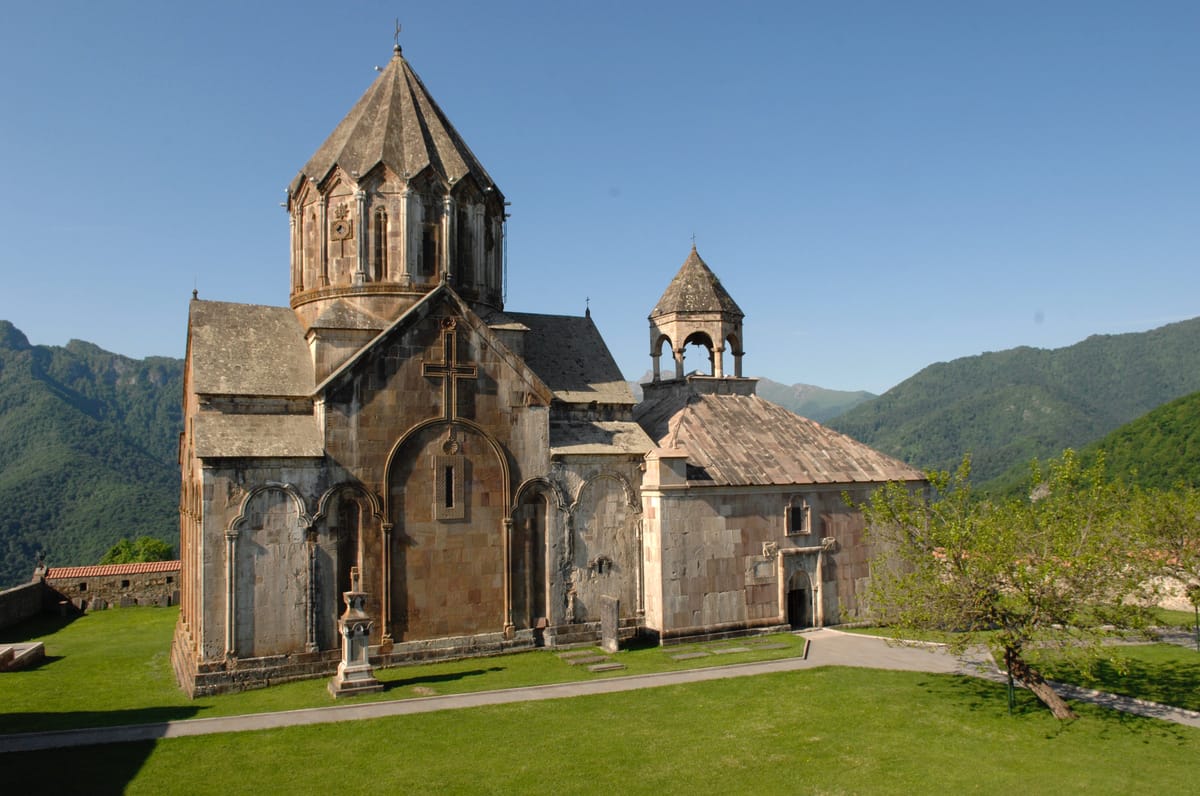
A newly released book documenting thousands of Armenian cultural and religious sites in Nagorno-Karabakh is being presented by its authors as a record of heritage at risk after a months-long blockade, a brief Azerbaijani offensive and the mass displacement of the region’s Armenian population in 2023.

Nagorno-Karabakh, known to Armenians as Artsakh, is a mountainous region within Azerbaijan. It is internationally recognized as Azerbaijani territory. From the early 1990s until 2023, it was controlled by ethnic Armenian authorities and linked to Armenia by a single corridor.

The blockade of that corridor, known as the Lachin Corridor, began in late 2022 and restricted the flow of food, fuel and medical supplies into the region. In September 2023, Azerbaijan launched a short military offensive, and local Armenian authorities agreed to disband. Within days, more than 100,000 ethnic Armenians fled to Armenia.

Azerbaijan has described the operation as restoring its territorial control and has disputed characterizations of the blockade.

In two volumes, The Tangible Cultural Monuments of the Republic of Artsakh documents 5,658 sites across 308 settlements, including churches, monasteries, cemeteries and khachkars, or carved stone crosses.

Notable Artsakh historians—including Vahram Balayan, Melanya Balayan, Lernik Hovhannisyan and Slava Sargsyan—co-authored the book, which was fully funded by the Boston-based Vahe Fattal Foundation. It is available in English and Armenian.

The book includes hundreds of photographs, along with maps and other materials intended to document and contextualize the sites. The authors said they hope it will “ignite renewed interest in both Armenian and foreign readers, especially considering recent geopolitical developments.”

“To ensure that this work is fully accessible to readers, we, the authors, elected to publish it as a photobook,” the authors said in a foreword.

For each site documented, the authors have included the monument’s name, a description of its location and GPS coordinates, as well as other data including its size and altitude above sea level. Each entry also includes multiple photographs and descriptive text explaining their significance, state of preservation and risks.

The authors of the book wrote that, since the 2023 mass exodus, Azerbaijani authorities “have embarked on a relentless campaign to destroy Armenian cities, villages, and monuments.”

They also accused Azerbaijani authorities of appropriating some of the sites by claiming that they are of “Caucasian Albanian” origin — a reference to a longstanding Azerbaijani position.

“Some of them, especially religious edifices, have already been destroyed, while others fell into disrepair or disappeared during Soviet-era Azerbaijan,” they said.

“Evidence of these cultural sites survives only in the memoirs of individual authors and travelers. Others have been recently distorted beyond recognition or repurposed, while the continued existence of the remainder is under imminent threat.”

The authors said in a statement on the project’s website that the book is “a critical reference” for the documentation and protection of such monuments.

“Our publication is a testament to the enduring resilience of Artsakh’s indigenous Armenians and the significance of safeguarding and preserving our Christian heritage,” said co-author Vahram Balayan in a news release.

“The concise inventory provides photographs of numerous sites—many of which were tragically and deliberately destroyed, altered, or remain at risk. By educating future generations, this critical documentation advocates for legal protections through relevant international platforms and organizations.”

 Stories like this take time, documents and a commitment to public transparency. Please support independent arts journalism by subscribing to Urgent Matter and supporting our work directly. 

Share this article
The link has been copied!