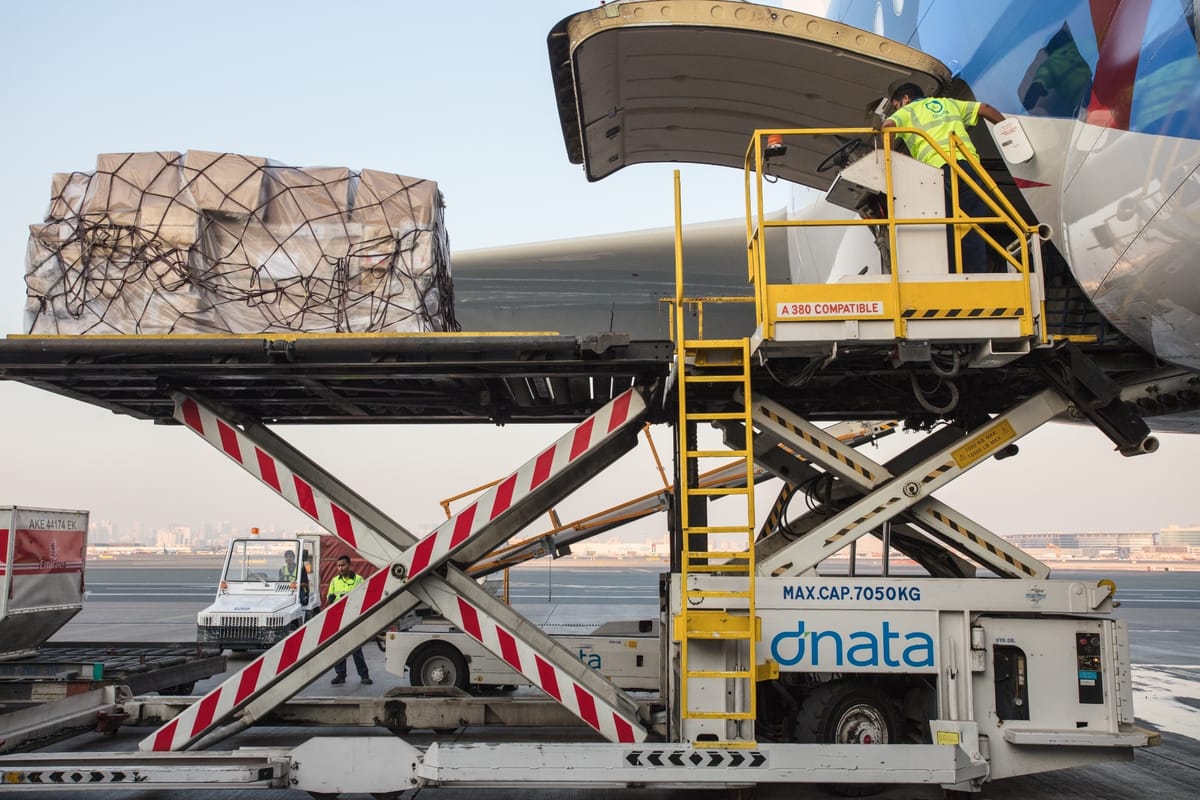
With sea shipping “not an option,” airspace restrictions and rising oil costs, art shipments to and from the Middle East are seeing major declines, fine art shippers told Urgent Matter.

The disruption is affecting shipments tied to art fairs, gallery exhibitions and private sales, where works often move on tight timelines and depend on coordinated air freight routes into regional hubs such as Dubai and Doha.

“Shipping by sea freight is currently not an option and the number of flights to the region has been significantly reduced with many that are scheduled being subject to last-minute cancellations,” said Alexander Bradford, the global business development and sustainability manager at Gander & White.

“Costs have increased due to the limited capacity alongside increased fuel charges caused by the oil price spike.”

Brent crude, the global benchmark for oil, reached a high of $119.50 per barrel in mid-March, increasing fuel costs for air cargo carriers, before falling back to around $98 per barrel as of Wednesday afternoon.

Bradford called the decline “dramatic” but said a low number of shipping requests continue amid the war.

“Both galleries and private clients are having to be flexible as the situation evolves and the availability of routes remains in flux,” he said.

Robin Eckstein, the regional manager of Hasenkamp Middle East, confirmed that there had been a noticeable decline in shipment volumes into and out of the Gulf Cooperation Council region, which includes Saudi Arabia, the United Arab Emirates, Qatar, Kuwait, Bahrain and Oman.

Eckstein said galleries and institutions are increasingly postponing or reassessing shipments, particularly for time-sensitive exhibitions, citing “broader uncertainty affecting the logistics environment.”

Art Dubai, which had been scheduled for April 17-19, recently announced it had postponed the fair to mid-May, and said it would be held in an "adapted" format. Eckstein pointed to the rescheduling of Art Dubai as an example where logistical feasibility played a role alongside other considerations.

“From an operational standpoint, routing and timing have been directly impacted. Limited commercial flight options, rerouting requirements, and evolving airspace conditions have introduced additional complexity into planning and execution,” Eckstein said.

“That said, our regional and global network remains fully operational. We are actively adapting by leveraging alternative routings, adjusting schedules, and working closely with airline partners to ensure continuity.”

Eckstein said that shipping delays are currently unavoidable but that most shipments could still be “reliably” executed with planning and coordination.

“Our priority remains the safety of artworks, our staff, and our partners, while maintaining the highest standards of service even in a challenging environment,” Eckstein said.

Insurers are also reassessing conditions in the region, with clients reviewing coverage for shipments and exhibitions amid heightened geopolitical risk.

"We have observed notable shifts in risk assessment practices, particularly following recent high-profile events such as the Art Basel Qatar edition," said Jennifer Schipf, global chief underwriting officer for fine art and specie at AXA XL.

Art Basel held its inaugural Qatar edition in Doha in early February, just weeks before the conflict broke out.

"Dealers transported significant volumes of inventory to Doha and there have been challenges in returning these works afterward," Schipf said.

"This situation is somewhat unusual, as most major art fairs tend to be hosted in regions with stable geopolitical climates and more established logistics infrastructure. The geopolitical considerations are now increasingly integral to risk evaluation."

Schipf said safety for staff, collectors and museum workers is now a key part of risk assessment for events like Art Basel Qatar and Art Dubai, given the security and logistical challenges of moving high-value works. Clients are also reviewing or expanding coverage, particularly for war-related transport and exhibition risks.

"This reflects a prudent approach by clients to mitigate potential exposure to unforeseen disruptions, political risks, or logistical complications," Schipf said.

Schipf said there will also be a reduction in exhibition and transit exposure following the rescheduling of Art Dubai.

"The entire insurance market is actively evaluating the evolving landscape, which is leading to a period of reassessment and potential adjustment," she said. "While specific coverage changes are still under discussion, there is a clear trend toward more conservative underwriting considerations."

Insurers are reviewing what risks they may exclude, including those tied to conflict, shipping disruptions or government actions. They are also taking a closer look at when and how works are transported, though coverage terms have not changed broadly yet.

Overall, insurers are proceeding cautiously as they evaluate how to respond to developments in the region, Schipf said.

"Insurers and clients are considering more detailed transit planning, including contingency measures and enhanced security protocols during transit," she said.

"These precautions aim to minimize the risk of seizure, theft, or damage, particularly given the heightened geopolitical sensitivities and logistical complexities in the region."

The extent to which the disruption continues may depend on the duration of airspace restrictions, the availability of commercial flights, and the passage of ships through the Strait of Hormuz, which remains highly uncertain as the conflict evolves.

Stories like this take time, documents and a commitment to public transparency. Please support independent arts journalism by subscribing to Urgent Matter and supporting our work directly.

Share this article
The link has been copied!