India’s Jaipur Art Week highlights new talent in UNESCO city
New talent and public art animate a UNESCO-listed city.

New talent and public art animate a UNESCO-listed city.
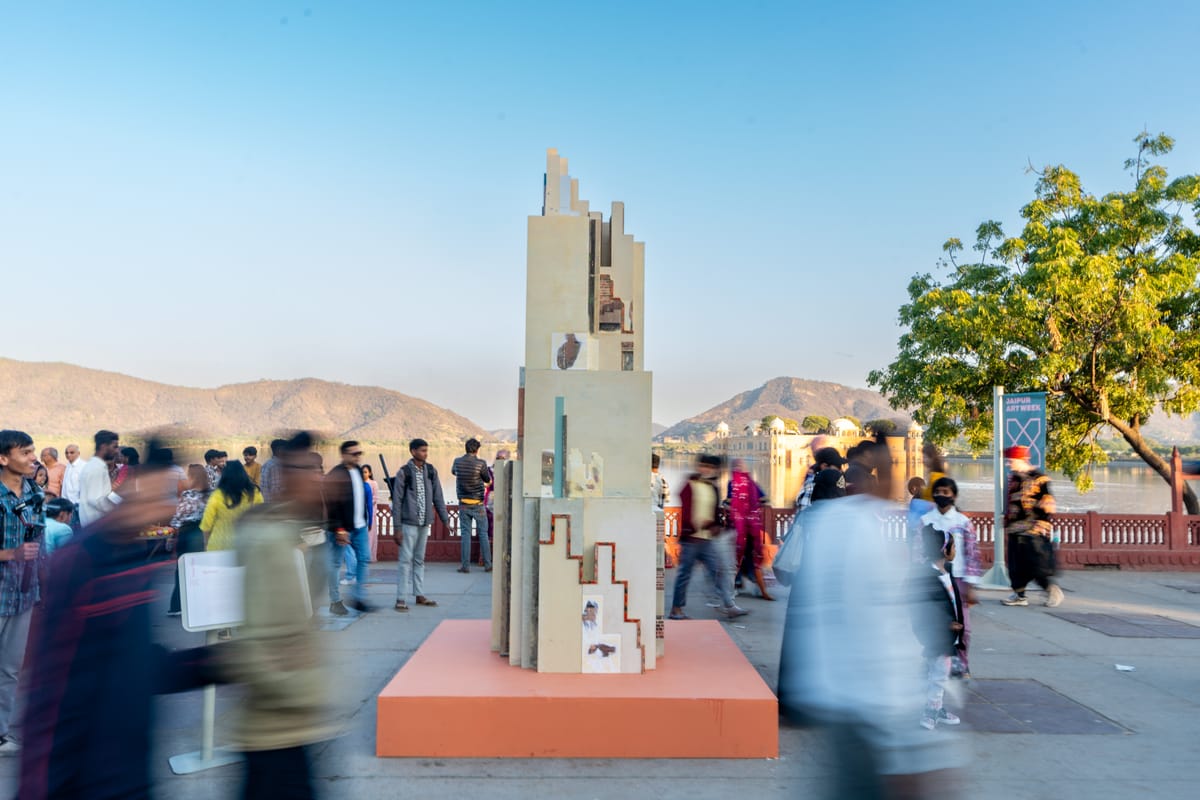
India’s Jaipur Art Week festival will return later this month with a citywide program anchored by an exhibition that emerged from a project titled “The Complexity of Democracy,” placing contemporary art into public and historic spaces across the city.
The fifth edition of the annual festival, which runs January 27 to February 3, centers on “Andha Yug,” a group exhibition developed with artists from the Greater Noida-based studio complex Kaladham. It is organized by the Public Arts Trust of India, a nonprofit founded by arts entrepreneur Sana Rezwan.
Earlier press materials described “The Complexity of Democracy” as the conceptual framework for the edition, before the project evolved into the site-specific exhibition “Andha Yug.”
In written responses to Urgent Matter, curator Anita Dube clarified that “The Complexity of Democracy Part I & II” were commissioned by Art Heritage and exhibited at their gallery in January and August 2025. Dube said they functioned as prior research and exhibition framework, from which “Andha Yug” emerged as the current iteration.
“The exhibition examines questions of chosen blindness, power, violence, faith, fear, and collective responsibility, set against the backdrop of democratic erosion and global conflict,” organizers said in an updated news release. “The exhibition foregrounds the artist as a thinking, feeling subject, attentive to labor, material conditions and lived histories of class, caste and postcolonial imbalance.”
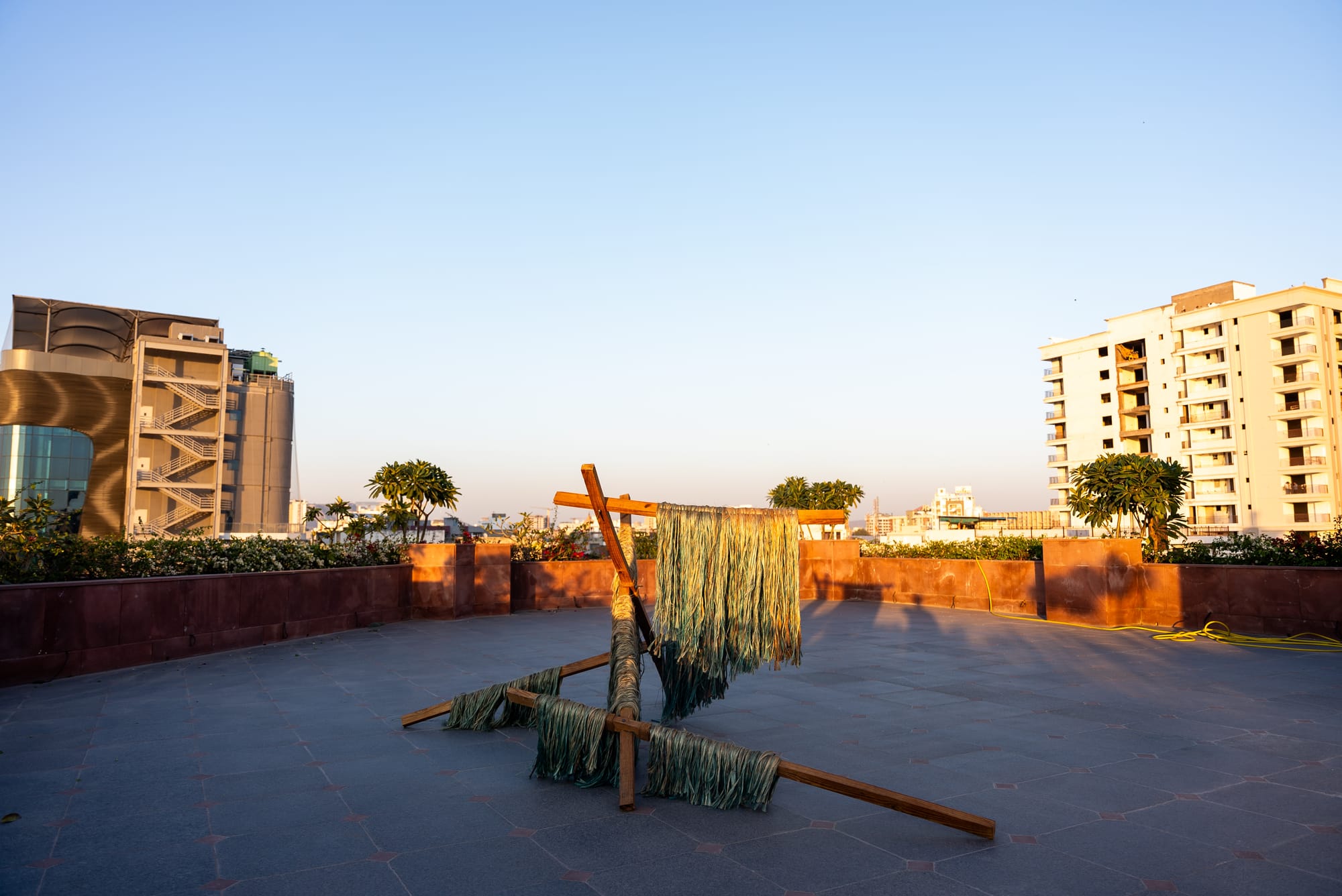
Dube said in her written responses that organizers shifted to a “new curatorial frame” inspired by Dharamvir Bharati's celebrated play Andha Yug. Because of the research and relationships forged with artists working in Kaladham for the earlier project, she was inspired to “think afresh with different artworks.”
“The exhibition does not intend to illustrate the play, rather it intends to reflect on the human condition of our present time through visual means,” she said.
“Since this iteration is not connected to the idea of democracy, it does not directly deal with power and governance. However, there is an attempt to show the imbalances in our postcolonial condition that challenge the liberal notion of a level playing field for its citizens. Class, caste, religion and economic background create unwritten hierarchies of privilege that require questioning.”
Dube distinguished between direct engagement with governance and broader examinations of power, inequality and violence that shape social life.
Before Urgent Matter was aware of the shift in the curatorial framework, Dube was asked how artists address ideas of power and governance, as well as questions about visible shifts around public speech, protest and cultural expression in recent years.
“The idea of power and its relation to violence against nature and 'othered' human beings is a major thread running through this exhibition,” she said.
But she added that the exhibition “does not speak in an activist voice” and instead with “a melancholic philosophical voice, as a meditation on the human condition in the midst of violence, intolerance and consumerist excess.”
“Andha Yug” anchors a broader festival that spreads exhibitions, installations, talks and workshops across Jaipur, a city designated a UNESCO World Heritage Site in 2019.
According to organizers, the 2026 edition features more than 100 participating artists, including over 15 solo presentations, selected from more than 450 proposals submitted through an open call. Programming across the week is free to access, a point organizers said reflects the festival’s emphasis on public engagement and accessibility rather than ticketed or market-driven formats.
Jaipur Art Week operates outside the commercial gallery model common to many international art weeks, emphasizing public access and early-career artists.
“While art week or art weekends are common constructs across the world today in major art cities, what makes Jaipur Art Week distinct is the focus on early-career and emerging artists, coupled with art exhibitions in public spaces and heritage locations which sit outside commercial gallery environments,” Dube said.
She said the rich cultural heritage of Jaipur also enables organizers to offer engaging programming like heritage and gastronomical walks through the walled city, Tarkashi craft, block printing and miniature painting workshops.
“The event has over the last four editions allowed artists to respond to both the historical monuments and sites, along with widely accessible public spaces like museums and parks,” Dube said.
Organizers describe that approach as central to the festival’s mission.
“The festival continues to build on PATI’s mission to democratize the arts, transforming the historic city into a living laboratory for experimentation and critical inquiry,” Rezwan said in written responses to Urgent Matter.
Artist selection relies heavily on an open-call model. Selected artists receive mentorship as they develop work for exhibition from more experienced artists such as Gigi Scaria, Vibha Galhotra, and Thukral & Tagra.
The program also includes an exhibition developed in collaboration with the Parsons School of Design’s photography department in New York. Titled “Surface Tension,” the exhibition brings together 19 artists and reflects Jaipur Art Week’s efforts to situate emerging Indian artists within broader international academic and institutional exchanges.
Working in public space required sustained conversation between curators and artists, Rezwan said. She was asked whether there were conversations with artists or venues about limits, sensitivities or boundaries when working in public spaces.
“The conversations that curators have with artists, especially empathetic one-to-one human conversations, range from financial situations or constraints; trajectories and potentialities within work that could emerge; earlier work and new directions,” she said.
“In short, an attempt to understand where the artist is coming from, where he is trying to go. Self-censorship is not encouraged as a choice, but freedom of creative expression is looked at as an artist-citizen's responsibility and right.”
In addition to physical installations, Jaipur Art Week includes a digital and new-media exhibition engaging artificial intelligence and emerging technology. The exhibition, titled “Here and Now,” focuses on artists working beyond conventional materials.
“A.I. and emerging technologies shape how art circulates today by accelerating visibility, collapsing distance, and redistributing agency,” Rezwan said.
“They shape narratives, expose power embedded in data, and enable artists and audiences to renegotiate representation, authorship and control.”
Rezwan said international audiences are increasingly engaging with Indian contemporary art, which has largely benefited established figures.
“While that has enabled established and mid-career artists to find support and validation, we also need to create an ecosystem that supports early-career artists, which Jaipur Art Week endeavors to do,” she said.
“It is not as much a push back, but about spotlighting underrepresented voices of emerging artists who may fly under the radar for international audiences who may be more focused on the bigger names in Indian modern and contemporary art.”
Correction at 10:13 a.m. on January 12, 2026: An earlier version of this article attributed all written responses to curator Anita Dube. Some of the responses were provided by Rezwan.
Stories like this take time, documents and a commitment to public transparency. Please support independent arts journalism by subscribing to Urgent Matter and supporting our work directly.