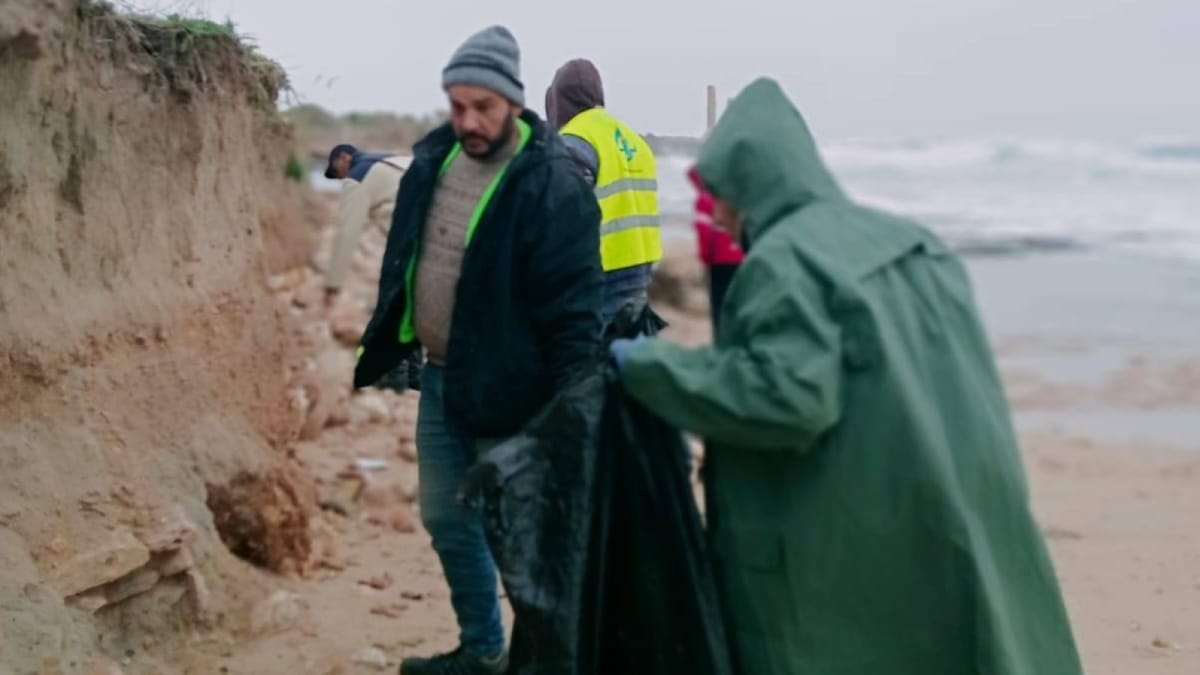
Devastating flooding that has killed at least five people in Tunisia this week has also led to the emergence of archaeological remains along the country’s coastline. Photo courtesy of Tunisia's Culture Ministry
Devastating flooding that has killed at least five people in Tunisia this week has also led to the emergence of archaeological items along the country’s coastline, authorities said.
Since Monday, Tunisia and parts of the Middle East and North Africa region have been inundated with record-breaking rainfall, the heaviest in more than 70 years, AFP reported.
Authorities said the flooding has killed at least four people in the town of Moknine and a fifth person in Nabeul, while at least four people remain missing. While the rain and flooding have slowed, Tunisian authorities remain on high alert.
“Following the exceptional weather conditions experienced in Tunisia in recent days, strong waves along the coast, particularly in the governorates of Nabeul and Mahdia, have caused a number of archaeological finds to emerge,” Tunisia’s Culture Ministry said in a statement. The discoveries were not detailed.
The ministry said a scientific team was dispatched to Nabeul to conduct on-site inspections, documentation and an overall assessment of the condition of Neapolis and nearby sites. Neapolis was an ancient Greek- and Roman-era port city that was partly submerged by a tsunami in 365 A.D.
Ahmed Qadoum, a researcher and director of the Underwater Archaeology Department, said that “scientific intervention requires caution and verification” because of the ongoing weather conditions along the coast.
“The continued pounding of the waves hinders the completion of the survey under normal conditions, requiring researchers to exercise caution and repeat the survey under normal conditions,” Tunisia’s Culture Ministry said.
The ministry said a regional heritage inspection team was also sent to Mahdia to assess coastal archaeological sites, including Borj Er-Ras and Salakta, and to implement what it described as necessary protective measures.
Qadoum said protecting archaeological sites located directly along the coast remains only partially effective because of their exposure to marine erosion.
He added that a coastal development project scheduled to begin soon in Nabeul under the supervision of the Environment Ministry could help reduce some of the risks facing coastal heritage sites.
Share this article
The link has been copied!
Members Discussion
Your link has expired. Please request a new one.
Your link has expired. Please request a new one.
Your link has expired. Please request a new one.
Great! You've successfully signed up.
Great! You've successfully signed up.
Welcome back! You've successfully signed in.
Success! You now have access to additional content.