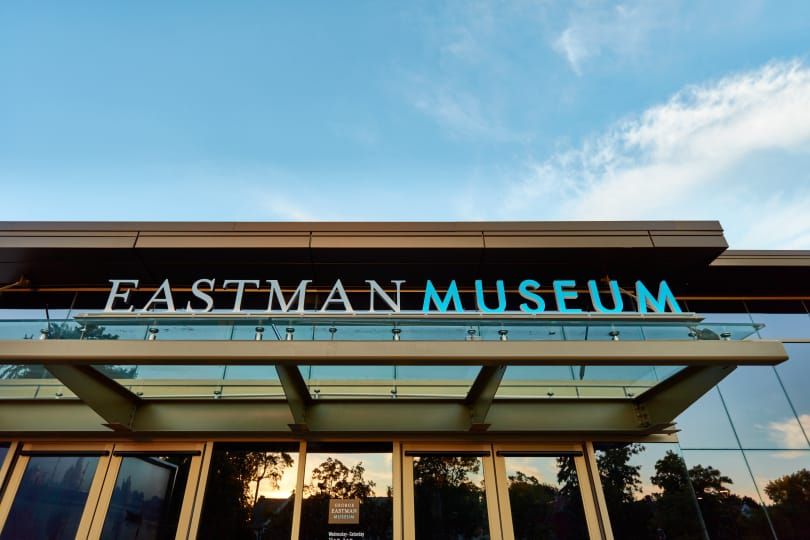
Workers at the George Eastman Museum in Rochester, New York, have filed for a union election with the National Labor Relations Board. They said the museum has responded by bringing in an outside consultant they described as anti-union.
Zachary Cabanas, an assistant preservation officer and one of five union members who spoke with Urgent Matter in a group interview by text message, said the consultant is Government Resources Consultants of America—which has worked on anti-union campaigns for companies like Amazon.
Cabanas said the consultant was brought on two weeks ago and scheduled meetings with small groups of employees during the workday, giving only 30 to 40 minutes’ notice. These “information sessions” were pitched as a way to “give us all the facts,” he said. Workers allegedly received no advance notice and were not told the name of the person or organization they would meet with.
“A lot of what is being said in those meetings is misleading,” Cabanas said.
Sign up for Urgent Matter
This article is provided free with the support of paying subscribers. Not ready for a paid subscription? Sign up for a free account today.
No spam. Unsubscribe anytime.
In his session, Cabanas said, the consultant discussed “Laboratory Conditions” and told employees they could not get raises because the museum had to maintain the status quo. He said that was wrong because the museum could continue giving its usual annual raises.
When workers raised ending terminations without cause, Cabanas said, the consultant repeatedly called at-will employment “a law” that could not be changed. Staff countered that protections could be included in a contract, he said.
The union asked for equal time to make its case to employees and has seen no sign the museum will grant it, Cabanas said. In its first letter to leadership, the group included a list called “Fair Principles of an Election.” The meetings don’t follow those principles, he said.
The union hopes to avoid filing unfair labor practice charges with the NLRB and wants to work with the museum, Cabanas said. But it is prepared to file if necessary.
Bruce Barnes, the museum’s director, said he learned of the effort on August 28 and was “consulting with attorneys and considering how to proceed appropriately,” he told the Rochester Beacon.
The George Eastman Museum employs nearly 100 people, including projectionists, preservationists, restaurant workers, curators and administrators, the union said in an August 31 announcement.
Workers sent Barnes and the board a letter announcing their intent to organize with Workers United on August 28, then filed their election petition on August 31, saying a majority of employees back the union.
The union did not say how many workers signed authorization cards. The proposed bargaining unit would cover workers across the museum’s departments but exclude security staff, the Rochester Beacon reported.
The campaign began this summer, Emma Rathe, the museum’s manager of programs and exhibition production, told Urgent Matter. She said no single event set it off when asked about an incident involving Barnes, reported by the Rochester Democrat & Chronicle.
“No single event caused this, but rather systemic issues that have been ignored for years,” Rathe said.
Rathe said staff have raised concerns for years about salaries that reflect their expertise and education, workplace safety, and high turnover. Employees gave anonymous feedback for the Museums Moving Forward 2024-2025 Data Study, she said. This produced a strategic framework the museum has not prioritized in daily operations.
“In my four years at the museum, I have spent time advocating for myself and colleagues with both management and HR. Many of my concerns regarding salaries and safety in the workplace have been ignored,” Rathe said. “Being a part of a union ensures that we can foster a workplace that is sustainable and safe for all of my colleagues—current and future.”
On safety, Rathe said the museum does not adequately pay or protect employees who handle hazardous materials like nitrate. She said essential staff were required to work onsite during the height of the COVID-19 pandemic. There have also been many reports of sexual and verbal harassment at the museum.
Turnover is hard to quantify because management stopped informing staff when colleagues are hired, fired or resign, Rathe said. At a December 2022 all-staff meeting, she said workers were told turnover had reached 50% that year. She added that figure is likely lower now but is the most recent one she has.
Rathe said workloads have grown unsustainable as programming, attendance and collection care increase while staffing and salaries remain flat.
“Through collective bargaining, we are hopeful that we can come to an agreement about what an appropriate workload looks like for all staff at the museum,” she said.
Damien Spader, a technology collection manager, said greater transparency could mean more notice to staff before decisions and more all-staff meetings. He said one of the union’s goals is to give everyone affected by policy changes, including the public, an equal voice.
Louis Chavez, an assistant curator, said the campaign concerns the museum’s Rochester home and its staff. The museum’s Los Angeles initiative is in its early stages, with no second venue yet, Chavez said, so the effort does not relate much to that location.
The Eastman campaign is part of a wave of organizing at art museums. Union activity at private, nonprofit art museums has risen 221% since 2019, according to research from Museums Moving Forward.
Workers United, an affiliate of the Service Employees International Union, represents museum staff at the Sciencenter in Ithaca and the Buffalo AKG Art Museum. A 2025 organizing drive at Rochester’s Strong National Museum of Play failed.
Chavez tied the timing to Rochester’s labor history, noting the museum hosts a Labor Film Series produced with the local labor federation since 1989.
“This was an opportune time to push for greater solidarity among members within our workplace,” Chavez said.
Urgent Matter is reader-supported. Please consider subscribing to support independent arts journalism.