Carabinieri recovers original handwritten papal letter by Pope Clemente X
The manuscript is a letter Pope Clement X wrote to the Bishop of Pesaro or the bishop’s vicar general on May 8, 1673.

The manuscript is a letter Pope Clement X wrote to the Bishop of Pesaro or the bishop’s vicar general on May 8, 1673.
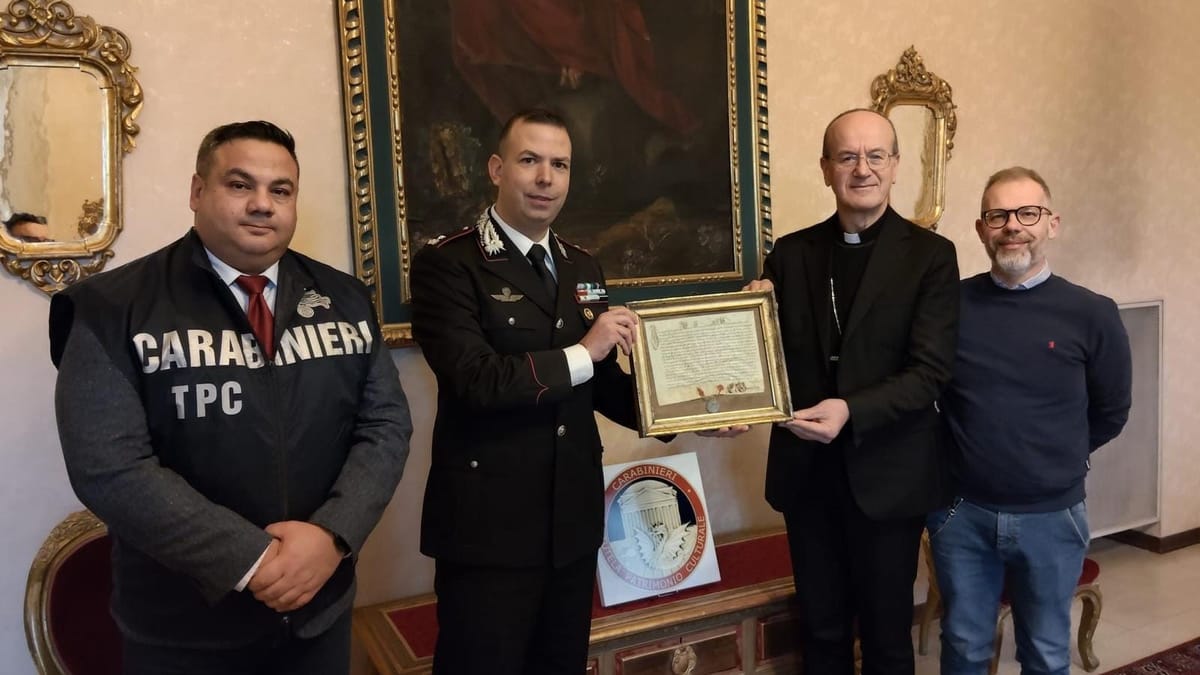
Italian police have returned a rare 17th-century papal document to the Archdiocese of Pesaro after it was identified for sale at a local antiques market and confirmed to be a protected cultural object, authorities said.
The handwritten manuscript, a papal bull issued by Pope Clement X, was returned by Italy’s specialized art-crime unit, the Carabinieri Command for the Protection of Cultural Heritage, in a ceremony attended by the Archbishop of Pesaro and other church officials.
The Carabinieri said in a statement last week that the document was first flagged in 2018 during targeted inspections of the monthly antiques market in Campello sul Clitunno, a small town in central Italy.
Investigators discovered the manuscript displayed for sale at an exhibition stand, prompting its seizure and further examination.
 Adam Schrader
Later investigations were coordinated by public prosecutors and conducted with the assistance of Italy’s archival and bibliographic superintendency for the Umbria and Marche regions. Investigators confirmed the document's authenticity and its classification as a cultural asset protected under Italian law.
The manuscript is a letter Pope Clement X wrote to the Bishop of Pesaro or the bishop’s vicar general on May 8, 1673.
In the letter, the pope granted authorization for Masses to be celebrated at a site in Pesaro where a murder had occurred a decade earlier.
“The return of the manuscript, which is of considerable historical interest, also has a strong symbolic value, giving the community of Pesaro back an authentic testimony of its ecclesiastical and social history,” the Carabinieri said.
No charges were announced in connection with the attempted sale, and authorities did not disclose how the document originally left church custody.
The Carabinieri described the case as an example of its ongoing efforts to safeguard Italy’s cultural heritage.
Last month, Italian authorities launched helicopter-backed raids, swooping down on suspected tomb raiders, traffickers and middlemen—some with alleged mafia ties—accused of grave robbing ancient artifacts and funneling them into the international black market.
Stories like this take time, documents and a commitment to public transparency. Please support independent arts journalism by subscribing to Urgent Matter and supporting our work directly.