Bronze-Age swords, arrowheads seized in Philadelphia after UAE shipment
The artifacts arrived on an express delivery flight from UAE on October 16 and were bound for an address in Jacksonville, Florida.

The artifacts arrived on an express delivery flight from UAE on October 16 and were bound for an address in Jacksonville, Florida.
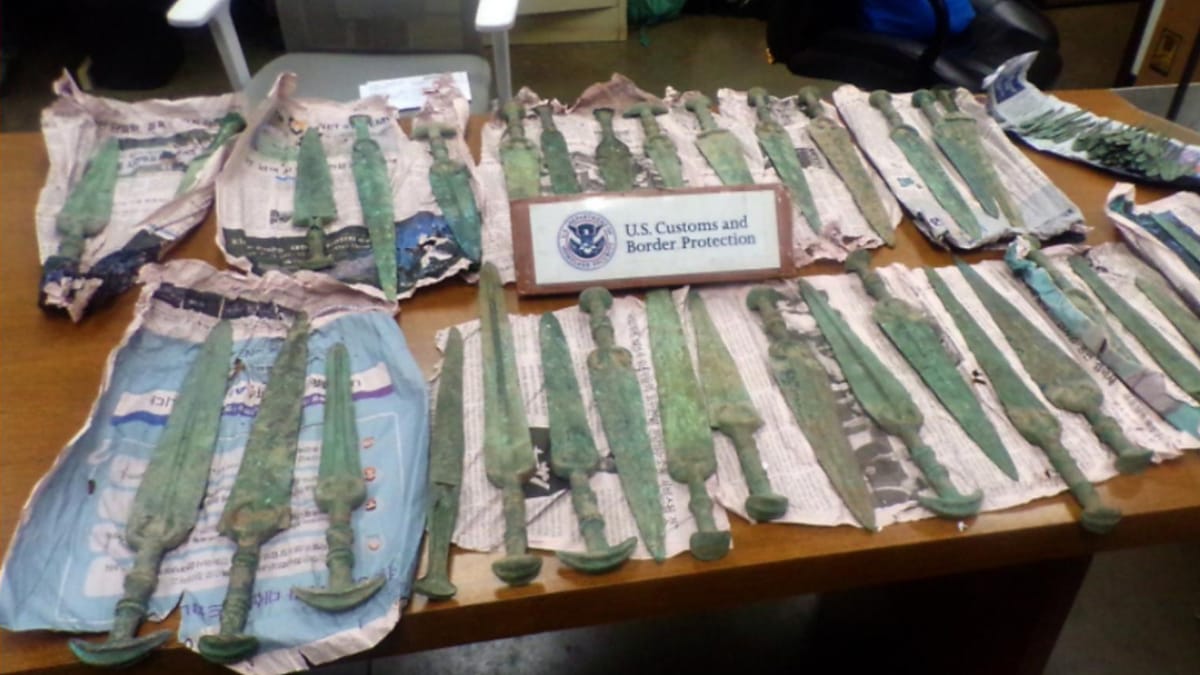
Dozens of Bronze-Age swords and arrowheads believed to have originated in northern Iran were seized by U.S. Customs and Border Protection officers in Philadelphia after arriving on a shipment from the United Arab Emirates.
The 36 copper-alloy short swords and 50 copper-alloy arrowheads were seized on February 18, CBP said in a statement last week.
Customs officials said the unlawfully imported artifacts had arrived on an express delivery flight from UAE on October 16 and were bound for an address in Jacksonville, Florida.
“CBP officers x-rayed the shipment, which was manifested as metal decoration articles, and detected sword-like objects,” the agency said in its statement.
“Officers then opened the shipment and discovered the swords and arrowheads. Officers suspected the items to be cultural artifacts and detained the shipment for further investigation.”
CBP officers reached out to the National Targeting Center’s Antiquities Unit, which in turn asked an archaeologist at a Philadelphia university with extensive Middle East experience to assist. The archaeologist, who was not identified by the agency, authenticated the items on February 13.
The archaeologist determined that the artifacts originated from an area along the southwestern Caspian Sea near the Talish Mountains region of Iran between 1600-1000 BCE, and “are suspected to have been derived from illicit excavations of burial sites.”
The agency said CBP officers will safeguard the artifacts until a formal decision is made about what should happen to them.
“Customs and Border Protection officers strive to rescue cultural artifacts from the grips of illicit international traders who plunder and exploit another nation’s heritage for profit,” said Elliot N. Ortiz, CBP’s acting area port director in Philadelphia.
“The deceptive practices used to smuggle these treasures into the United States not only violate our import laws but also undermine efforts to preserve and protect the integrity of cultural history.”
The news comes after Urgent Matter revealed through a Freedom of Information Act request that CBP closed six cases that included seizures of art and antiquities handled by its New York Field Office in 2025.
 Adam Schrader
Among those cases were seizures of ancient coins, which came in commercially declared shipments sent by mail parcel, declared as originating in Egypt, and exported or routed through the UAE before arriving in the United States. While CBP redacted most information related to the violators, the records show they were an Emirati person or entity.
Urgent Matter has requested additional records from CBP to determine how frequently shipments involving works of art exported from or routed through the United Arab Emirates have been seized nationwide.
Stories like this take time, documents and a commitment to public transparency. Please support independent arts journalism by subscribing to Urgent Matter and supporting our work directly.