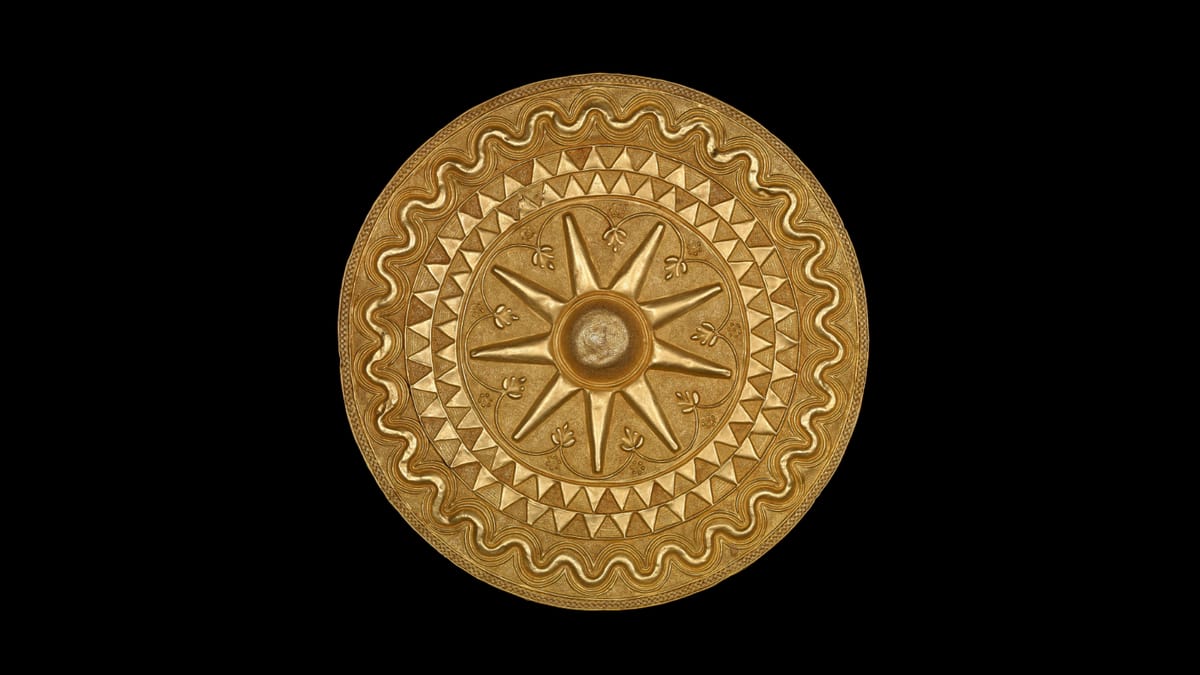
A previously undisclosed 1991 theft at the British Museum included a gold disc pendant from the Asante Empire in modern Ghana and two pre-Columbian vases, according to a new book by historian Barnaby Phillips.
A guard making gallery rounds at the Museum of Mankind discovered in October 1991 that the wooden display case housing the gold disc had been forced open, Phillips revealed in his book The African Kingdom of Gold: Britain and the Asante Treasure. A screwdriver was reportedly left behind at the scene.
The British Museum reported the theft to police, and the Museum of Mankind—then home to the museum’s ethnographic collection—was temporarily closed while staff and visitors were searched, Phillips said.
The vases were recovered in Brussels, Belgium, weeks after the theft when a suspicious dealer raised the alarm. But the gold disc remained missing.
Tracing how the gold disc changed hands, Phillips said that it was in the possession of the late German collector Karl-Ferdinand Schaedler by 1994. Schaedler loaned the gold disc to at least two museums, including the Museum für Völkerkunde in Vienna.
In 1999, Schaedler sold it through Sotheby's and it was bought by the Indianapolis Museum of Art in Indiana. The museum in 2002 then created a logo for an African art festival inspired by the gold disc that also appeared on T-shirts.
The design caught the attention of Doran Ross, a Ghanaian art specialist at the Fowler Museum in California, who recognized similarities with the stolen object. The disc was returned to the British Museum that year.
But Phillips said that the British Museum “disingenuously” updated its webpage in 2025 to indicate that the disc had been displayed at museums in Indianapolis and Europe, but made no mention of the theft. He also criticized Sotheby’s, questioning whether it had diligently researched the artifact before selling it in 1999.
In the collection listing for the artifact on its website, the British Museum still does not make note of the theft, according to a review by Urgent Matter. But it does note the questionable provenance of how the museum acquired it in the first place.
The British Museum said the gold disc was given to it by Bignell Elliott, a London timber merchant with no recorded association with Africa. “It is unknown how he acquired this disc pendant,” the museum acknowledged.
Phillips’s book also details a separate internal theft case involving Nigel Peverett, a worker in the museum’s prints and drawings department.
Peverett stole more than 350 artworks and sold some of them to antiques dealers, according to Phillips.
He was reportedly caught in 1992 after being stopped while leaving the museum with 35 prints worth about £5,000. Police later recovered another 169 prints from his cottage in Kent, and he admitted selling roughly 150 more.
The revelations come as the British Museum continues to face scrutiny over internal security following the discovery in 2023 that thousands of items had been stolen from its collection.
Follow along with other art crime stories at Urgent Matter’s art crime tracker.