Art Basel on Thursday will open its first fair in Qatar, marking the organization’s debut in the Middle East and a deeper expansion into state-partnered cultural markets, as the fair aligns itself with national investment and tourism bodies shaping the region’s cultural strategy.

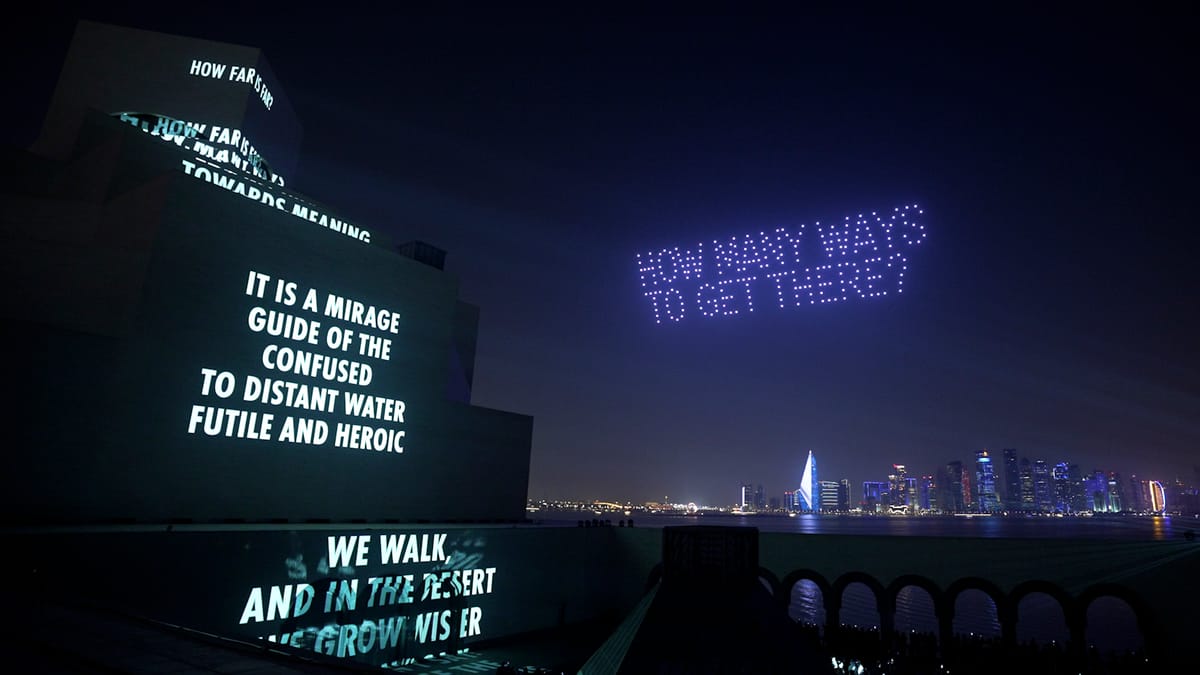
Conceptual artist Jenny Holzer staged a “surprise” premiere of a new work, titled Song, at Doha’s Museum of Islamic Art on Tuesday, ahead of the fair’s first preview day. It is the tenth work in the fair’s Special Projects program.

Shortly after guests began to arrive around 9 p.m. local time for a planned welcoming event, lights at the museum were dimmed to unveil the site-responsive artwork, Art Basel said in a news release.

The work unfolded as a tightly choreographed, 15-minute sequence combining large-scale architectural projection with a drone performance involving more than 700 devices — a scale rarely attempted outside state-supported cultural events.

It featured the poetry of Palestinian poet Mahmoud Darwish and Emirati poet and filmmaker Nujoom Alghanem simultaneously projected onto the side of the museum’s exterior and written in the air above Doha using the drones in English and Arabic script, according to video of the event.

The poems included Darwish’s celebrated 2008 poem Athar al-Farashah and The Earth is Closing in on Us, which describes the experience of living under siege.

Organizers said Holzer’s artwork “invites audiences to pause, read and reflect together,” a similar concept to a work by Es Devlin, commissioned by Faena Art, that debuted during Art Basel Miami Beach in December.

The artwork will be displayed nightly on the side of the building throughout the duration of the fair, which ends Saturday.

The fair is presented in partnership with Qatar Sports Investments, the state-backed entity that also owns Paris Saint-Germain, and QC+, and is backed by Visit Qatar, the country’s national tourism authority.

It brings together 87 international exhibitors presenting work by 84 artists, with more than half of those artists coming from the Middle East, North Africa and South Asia.

The fair is the fifth permanent location for Art Basel, which also stages annual fairs in Basel, Miami Beach, Hong Kong and Paris. But the Qatar edition is unique because it is embedded within a state-backed cultural infrastructure and departs from Art Basel’s standard booth model in favor of a multi-site, solo-presentation format.

Across the Middle East and North Africa, governments have increasingly expanded their cultural efforts to advance diplomatic interests, strengthen international partnerships, and project influence through museums, heritage policy and high-profile arts initiatives.

In the United Arab Emirates, cabinet officials in December moved to draft a federal heritage law after a period of major museum openings and increased investment in cultural infrastructure.

Qatar has taken a comparable approach, backing museum expansion and high-profile international partnerships as part of a broader effort to establish Doha as a global cultural destination.

Sheikha Al Mayassa bint Hamad bin Khalifa Al Thani, the sister of Qatar's ruling emir and chair of Qatar Museums, said in a statement ahead of the fair’s opening that the country aims to “curate a platform that uplifts the creativity of an entire region.”

“This is the beginning of a bold, exciting, and truly unique undertaking,” she said, “one that merges with and amplifies the cultural and artistic ecosystem we have been building, piece by piece, for the past 50 years.”

Stories like this take time, documents and a commitment to public transparency. Please support independent arts journalism by subscribing to Urgent Matter and supporting our work directly.

Share this article
The link has been copied!