American artists criticize U.S. move to control TikTok operations
Artists say TikTok’s new U.S. joint venture raises fears about surveillance, political influence and changes to content.

Artists say TikTok’s new U.S. joint venture raises fears about surveillance, political influence and changes to content.
After years of scrutiny and bipartisan concern over TikTok’s data security and ties to China, the company said Thursday it has formed a new majority American-owned joint venture aimed at complying with a 2024 federal law that requires divestiture or risks a U.S. ban.
The joint venture was established under a Trump-era executive order that set the framework for TikTok to continue operating for U.S. users while the company works to meet federal security and ownership requirements.
The new entity, TikTok USDS Joint Venture LLC, will operate as an independent company responsible for securing U.S. user data, the TikTok app and its recommendation algorithm, and overseeing content moderation for U.S. users, according to the company.
Under the new structure, U.S. user data will be stored in Oracle’s U.S.-based cloud infrastructure and protected through a cybersecurity program audited and certified by third-party firms.
Larry Ellison, Oracle’s co-founder and longtime chairman and chief executive, is a prominent supporter of Donald Trump, whose administration issued the executive order governing the joint venture.
TikTok said the program will adhere to industry standards, including those set by the National Institute of Standards and Technology and the Cybersecurity and Infrastructure Security Agency.
The joint venture will also retrain, test and update TikTok’s recommendation algorithm using U.S. user data, and it will conduct ongoing source-code reviews and software validation. This is the most consequential part of the deal. TikTok’s recommendation algorithm is the system that decides what goes viral and what disappears.
Retraining that system on U.S. user data and running it inside a U.S.-based cloud places control over how content is ranked and surfaced for American users inside the United States, making the platform’s core decision-making system more directly subject to U.S. legal and regulatory authorities.
Despite the changes, TikTok said the platform will remain interoperable with its global services, allowing U.S. creators and businesses to reach international audiences.
The joint venture’s managing investors—Silver Lake, Oracle and MGX—will each hold 15% stakes, according to the announcement. ByteDance, TikTok’s China-based parent company, will retain a 19.9% ownership interest, with the remaining shares held by a consortium of U.S. and international investors.
TikTok said the measures put in place under the joint venture will also apply to CapCut, Lemon8 and other apps and websites it operates in the United States.
The changes are already visible to users. TikTok has begun displaying an in-app notice informing U.S. users that it is updating its Terms of Service and Privacy Policy, effective Thursday, to reflect the creation of the new corporate entity and expanded data practices.
The notice advises users that the company may collect new types of location information, including device geolocation with user permission, and use collected information to deliver advertising outside the TikTok app, with an opt-out option available to users.
American artists with massive TikTok followings criticized the sale and expressed concern about the new policies.
“It’s becoming clear that our government does not see TikTok as a frivolous dance video app, but instead as a propaganda tool which can be leveraged to share carefully crafted narratives with the general public,” Isa Obradovich, an artist with more than a million followers and 46.8 million likes across her videos, told Urgent Matter.
Obradovich said she joined the platform in 2019 and amassed a following by sharing her artwork and her journey as a college student studying art education.
But she also used the platform to stay up to date with current events as told through diverse perspectives from people around the world outside of mainstream American media. More than 20% of American adults regularly get their news from TikTok, according to the Pew Research Center.
“The United States benefits from buying control over the algorithms of US-based TikTok users because once they own the algorithm, they effectively control the flow of information for tens of millions of daily users who are using this app to get their news,” she said.
Obradovich said TikTok has played an outsized role in shaping public opinion around the Israel-Palestine conflict by allowing footage and commentary to circulate directly to viewers, enabling widespread exposure to images from the war that have shifted sentiment among younger users.
She pointed to comments by Israeli Prime Minister Benjamin Netanyahu in a September meeting with U.S.-based influencers in which he described social media platforms including TikTok as among “the most important weapons” to influence U.S. opinion.
And she raised concerns about Oracle’s role in the new joint venture, citing co-founder Larry Ellison’s publicly documented support for Israel and longstanding ties between the company and the U.S. government.
“My guess is that we are going to see a lot less pro-Palestine content on our feeds, as well as less content that is generally critical of Israel or the United States altogether,” she said.
Perry Picasshoe, a 25-year-old artist from Riverside, California, with 167,000 followers, said he fears that TikTok will now follow the trajectory of the social media platforms that came before it.
“I saw what happened to Facebook, Twitter and even Instagram, where these companies prioritize profit and staying good with the American government,” he said.
“I worry, though, that I don't know where else to turn. If we all leave, there will just be a power vacuum, like what happens when people left Twitter, Facebook and Reddit and right-wing people took over the platforms.”
Though the new terms and conditions are “really uncomfortable,” he intends to stay on TikTiok, as it’s where he still gets much of his news, particularly on political topics like U.S. Immigration and Customs Enforcement and decisions by the Trump administration.
“Now that they have access to THE platform of the internet in addition to Twitter, I'm scared. Every other advertisement on Twitter is to join ICE. It's disgusting,” he said.
“Twitter was pretty liberal, like there were actual revolutions that took place because of it. Now, it's A.I. slop and Nazi shit. Facebook was for friends and family, and now it's impossible to not see A.I. slop. TikTok felt fresh.”
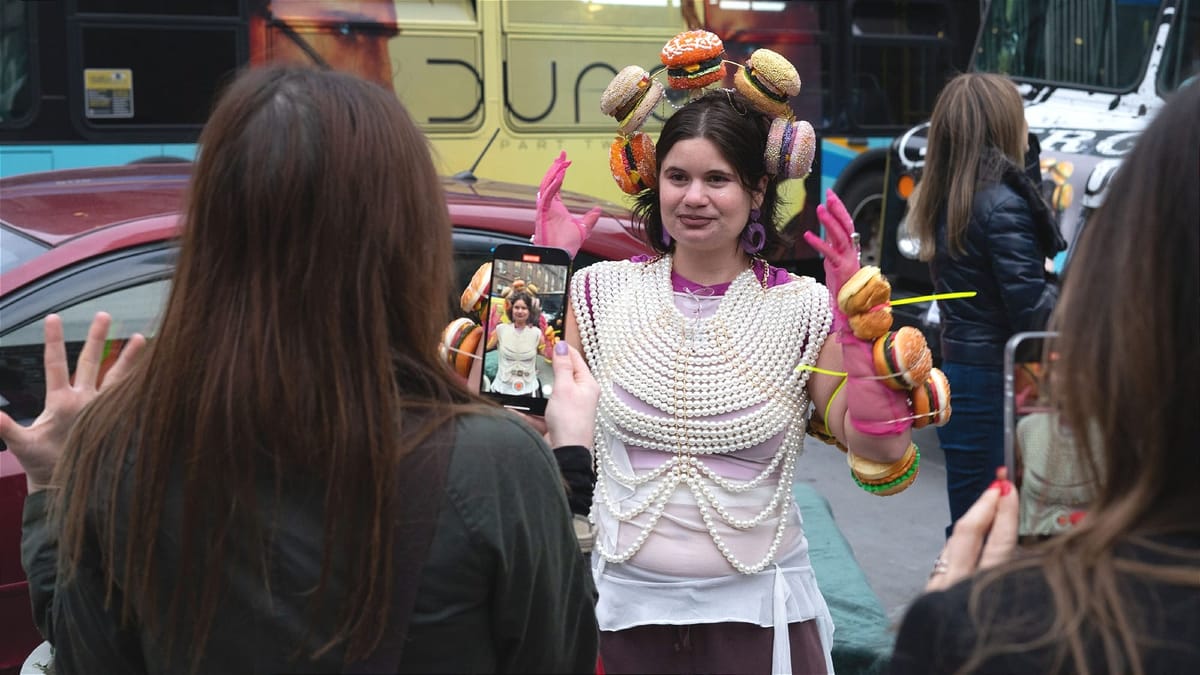
Vita Kari is a Los Angeles-based visual and performance artist whose work examines virality and digital culture. Kari has more than 1.3 million followers on TikTok, where they gained a large audience through their “The Craziest Thing About Being Creative” video series. Their work has been exhibited internationally, including in China and Mexico City.
“The location prompts are concerning to me,” Kari said. “I'm hoping that as a queer person career content can still be prioritized and shared.”
Kari said they plan to stay on TikTok and use the platform in ways that interrupt how content normally scrolls past users, rather than leaving the app. They said staying visible on the platform can itself be a form of resistance, allowing marginalized artists to challenge how viral content spreads by working inside the system instead of opting out.
“Also, I might use a VPN to change my location just for safety because, as a queer person, I do worry about ICE,” Kari said, referring to ongoing and chaotic enforcement actions from U.S. Immigration and Customs Enforcement.
 Adam Schrader
Kari said the new data practices raised fears for them personally. Given that the joint venture is newly announced, there is limited public information about how the data could be accessed or used by authorities.
But the artist, a U.S.-born citizen, said they were briefly detained in January 2025 while returning to the country from a trip to Trinidad. U.S. authorities demanded to search through Kari’s social media upon reentry.
“I am worried that data on my phone will be used against me, especially as more citizens are taken by ICE,” Kari said. “I’m not entirely sure how it would be used — maybe that I’m gay — but my grandfather was a Holocaust survivor, so I’m anxious.”
Updated at 12:38 p.m. on January 25, 2026: This story was updated to include comments received back from Perry Picasshoe after publication.
Stories like this take time, documents and a commitment to public transparency. Please support independent arts journalism by subscribing to Urgent Matter and supporting our work directly.