Amateur metal detectorist who faked Roman brooch discovery sentenced for fraud
The false claim prompted a multi-year police investigation.

The false claim prompted a multi-year police investigation.
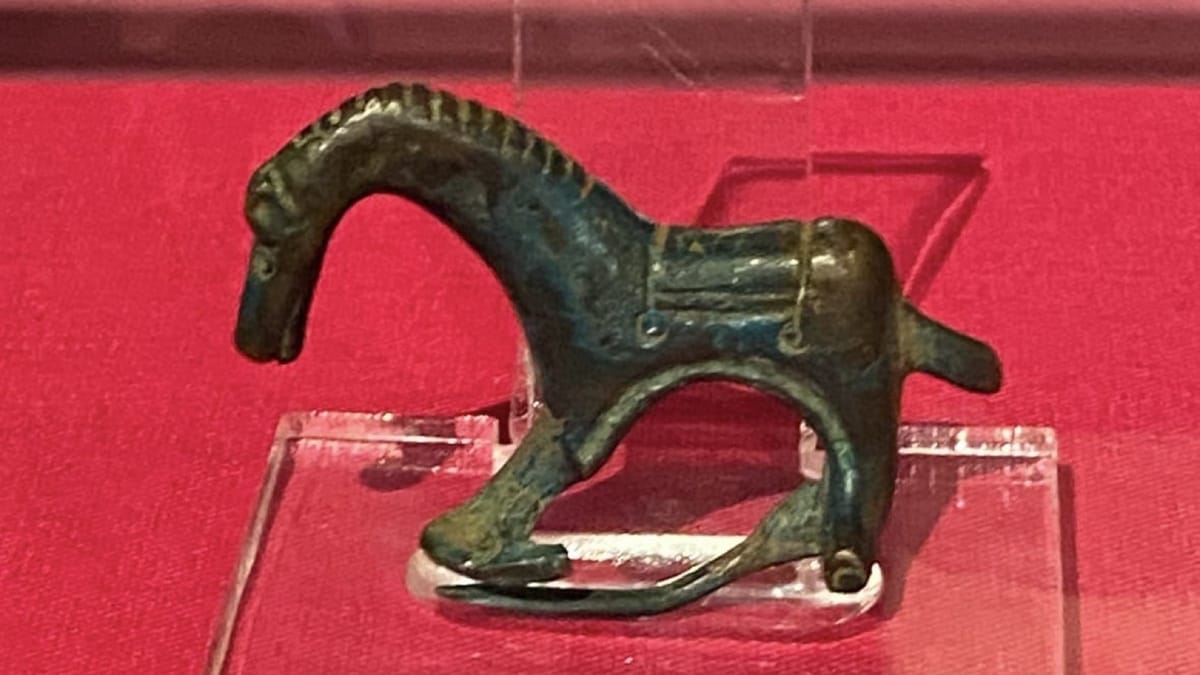
An amateur metal detectorist who faked the discovery of an Ancient Roman-era horse brooch has been sentenced after admitting he bought the purported artifact from eBay.
Jason Price, 54, had claimed to discover what later became known as the “Leasingham Horse Brooch” in 2019. Lincolnshire Police said in a statement that the purported discovery “led to a change in the historic understanding of Roman brooches in Britain.”
After a two-year investigation, Price was arrested in May 2025 and later pleaded guilty to four counts of fraud by false representation after admitting he bought it and other items he had claimed to discover off eBay.
Price was sentenced Thursday to 12 months in prison, suspended by two years. Under the British penal system, Price avoided immediate jail time and will only serve the sentence if he commits another crime within two years.
 Adam Schrader
He was also ordered to complete up to 10 days in a court rehabilitation program and 150 hours of what is essentially community service under the British penal system. In addition, he was ordered to pay restitution to Lincolnshire County Council and other fees.
Lincolnshire Police said the investigation into Price began in May 2023 when county officials raised their concerns over a number of finds that he had reported under the Portable Antiquities Scheme.
The Portable Antiquities Scheme is a voluntary recording system in England and Wales that allows members of the public who discover archaeological objects to submit them to local authorities for identification and documentation.
Finds submitted through the scheme are logged in a national database but do not, by themselves, determine ownership or trigger legal restrictions. Most items recorded under the scheme are deemed of historical interest and are typically returned to the finder, subject to agreements with the landowner.
Separate from the recording scheme, the U.K.’s Treasure Act imposes mandatory reporting requirements on certain objects, including items made of gold or silver that are more than 300 years old.
When a find qualifies as “treasure,” ownership is temporarily vested in the Crown, and the item is reviewed through a legal process that allows museums to acquire it at a value set by an independent panel, with any reward usually shared between the finder and landowner.
 Adam Schrader
In Price’s case, most of the items he submitted were recorded under the Portable Antiquities Scheme. One item, a silver Roman knee brooch, was recorded as treasure under the Treasure Act, police said.
Price initially raised suspicions when he submitted what he referred to as a Roman hoard, which he claimed to find while metal detecting at Long Bennington. He said the discovery included a horse figure with circular recesses, a Bronze Age axe, a pointed tool and a gold ring.
“The gold Roman finger ring was dismissed immediately as being a modern ring and not Roman,” police said. After testing, all the items were found to be modern reproductions with faux patina paint applied to make them look older.
Price then reported in August 2024 that he had made another discovery of a Roman coin hoard within a pottery vessel, copper alloy statues and figurines.
But when a site visit was requested to authenticate his claims, it was refused. Investigators found that there were no cuts in the soil, which would be expected in a deep buried hoard.
 Adam Schrader
The following month, experts determined that the coins were not what would be found together in a hoard and had not been buried in ancient times. And in January 2025, experts determined that the pottery discovered was likely modern.
But the “most notable” item Price claimed he had found was the horse brooch, police said. Independent studies had dated the brooch to the Roman period and it was classified as a significant find and recorded under the Portable Antiquities Scheme. Price received roughly $6,660 so it could be displayed at a local museum.
“In reality many of the objects submitted by Price had been purchased off eBay,” police said. “Tests revealed the Leasingham horse brooch was brass and had been painted with a faux patina effect. Price then fraudulently presented it as a significant find.”
Price told investigators he buried the items to get people interested in the site at Long Bennington in the hope that funds would be generated for a real archaeological dig.
Follow along with other art crime stories at Urgent Matter’s art crime tracker.