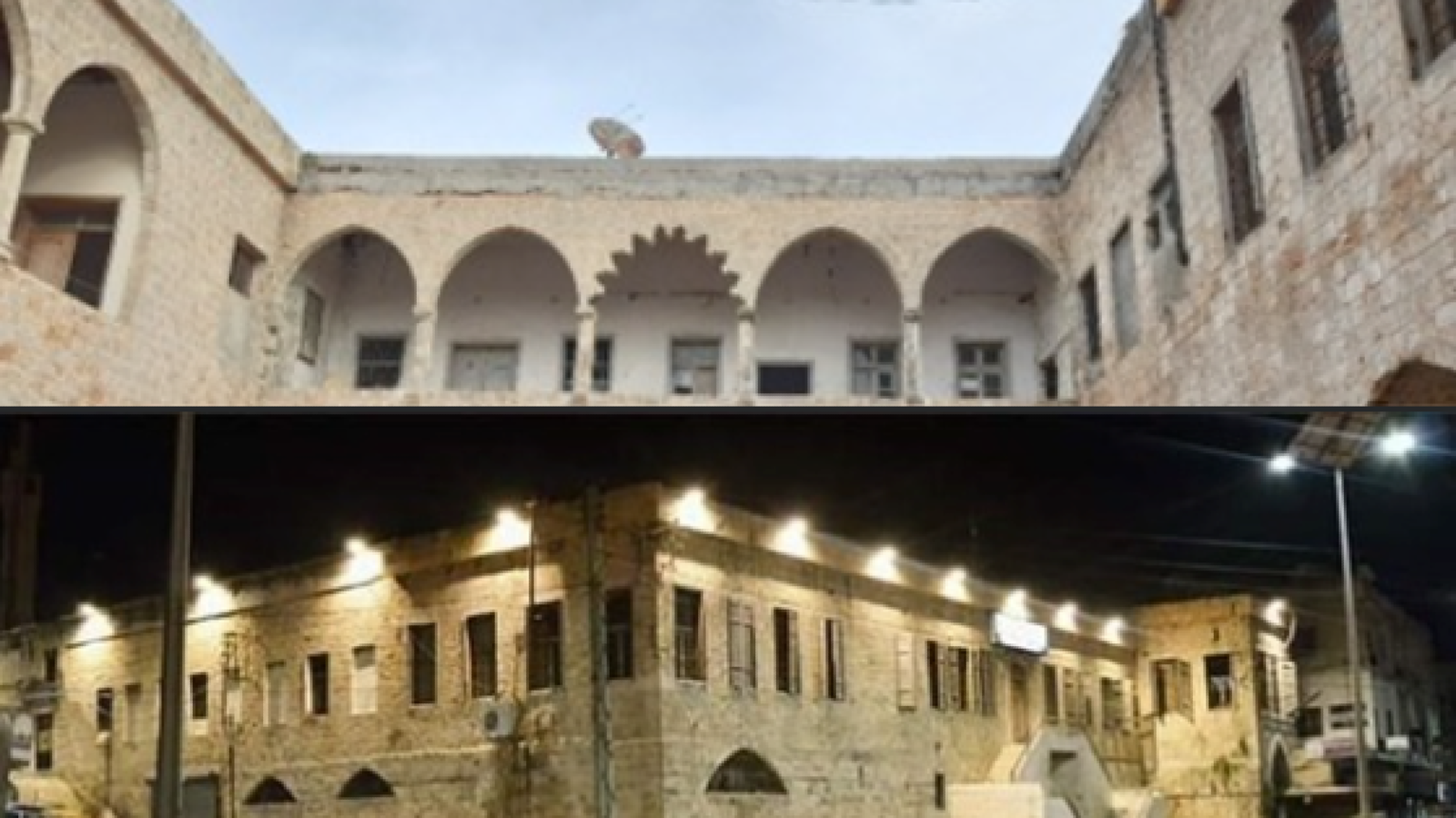
A screenshot shared by Syria's General Directorate of Antiquities and Museums announcing a purported museum project with the Aga Khan Trust for Culture
The Aga Khan Trust for Culture has denied reports that it plans to restore the historic Saraya building in the Syrian coastal city of Jableh, contradicting a recent announcement by Syria’s Directorate-General of Antiquities and Museums.
“I can confirm that the information you provided in your request is incorrect and we have no such plans,” an AKTC spokesperson told Urgent Matter in an email. “We are working with the relevant government department to correct their post.”
But the AKTC is working with Syria’s Directorate-General of Antiquities and Museums to identify priority heritage sites for restoration, the spokesperson added.
The clarification follows statements circulated by Syrian antiquities officials and the state-linked Wehda newspaper claiming that AKTC had submitted a project to restore the Mamluk- and Ottoman-era Saraya building, with the goal of converting it into a national museum.
Similar plans to rehabilitate the building were reported by state media agency SANA in 2021, though no public documentation shows the project was completed or that a museum ever opened. The new post appeared to revive those earlier claims, prompting questions about whether an international cultural organization had formally re-engaged.
“This collaboration is part of a partnership between the General Directorate of Antiquities and Museums and the Aga Khan Trust for Culture, and supports the goals of heritage preservation and restoration, which will have a positive impact on the city's cultural memory and provide educational and cultural opportunities for the local community,” Syrian officials had said.
AKTC’s denial indicates that the reported partnership does not exist and that the organization was misattributed as a project sponsor or collaborator. It remains unclear how or why the claim appeared in official channels, or whether it reflected outdated information, a misunderstanding or an internal planning proposal that did not involve the organization.
As of publication, Syria’s Directorate-General of Antiquities and Museums had not issued a public correction.
The Aga Khan Trust for Culture is widely known for its heritage restoration work across the Middle East, including major projects in Syria, making its involvement a frequent reference point in cultural redevelopment initiatives. Its participation can significantly shape how such projects are perceived internationally.
The Aga Khan Development Network, which includes AKTC, has been active in Syria for more than 25 years, working across humanitarian assistance, health care, agriculture, education, civil society support and cultural restoration, according to information published by the organization.
In 2025, the Ismaili Imamat pledged nearly $117 million over two years to support Syria’s recovery amid a prolonged humanitarian and economic crisis.
Over the past five years, AKDN says it has provided emergency food and nutrition assistance to about 500,000 people, delivered health, water and sanitation services to roughly one million, and reached 800,000 people through civil-society programs aimed at strengthening local institutions and social cohesion.
The network has also worked with about 50,000 farmers to improve food security and resilience to climate and economic pressures.
AKDN’s cultural arm has played a significant role in heritage restoration in Syria, particularly in Aleppo. The organization says it has restored 277 shops in the city’s historic souks and rehabilitated more than 500 meters of passageways in the Central Souk, one of the largest medieval markets in the Middle East.
The Aleppo souk was heavily damaged during the Syrian civil war, which began in 2011 under President Bashar al-Assad and saw intense fighting in the city between 2012 and 2016. Large sections of the medieval market were burned, shelled or collapsed during battles between government forces and opposition groups.
AKTC has also led conservation projects at major historic sites, including the Citadel of Aleppo, the Citadel of Salah al-Din near Latakia and the Citadel of Masyaf. Restoration work at Salah al-Din and Masyaf began in the early 2000s and focused on stabilizing Ayyubid- and Mamluk-era structures while preserving their historic character.
Following devastating earthquakes in 2023, the trust carried out emergency stabilization of several historic monuments in Aleppo with support from the ALIPH Foundation.
In March 2025, speaking at a European Commission conference in Brussels, Aga Khan V said the funding pledge was intended to scale up humanitarian assistance, expand health care and education, address food insecurity, invest in renewable energy and preserve Syria’s cultural heritage. He said long-term recovery would depend on an end to violence and the establishment of inclusive governance.
The Syrian conflict entered a new phase in late 2024 and early 2025 following the collapse of the Assad government and the flight of Bashar al-Assad to Russia, a shift that has altered how international organizations engage with reconstruction and development efforts in the country.
AKDN says it currently operates in seven Syrian governorates, working with more than 200 local partner organizations, and employs more than 780 staff in Syria, nearly all of them Syrian nationals, alongside hundreds of volunteers.
Despite those efforts, the organization notes that Syria continues to face widespread poverty, damaged infrastructure and limited access to health care and education after more than a decade of conflict.
Updated at 11:37 p.m. on December 17, 2025: A new comment from an AKTC spokesperson noting that the organization is working with Syrian authorities to identify priority heritage sites for restoration was added.
Stories like this take time, documents and a commitment to public transparency. Please support independent arts journalism by subscribing to Urgent Matter and supporting our work directly.
Share this article
The link has been copied!
Members Discussion
Your link has expired. Please request a new one.
Your link has expired. Please request a new one.
Your link has expired. Please request a new one.
Great! You've successfully signed up.
Great! You've successfully signed up.
Welcome back! You've successfully signed in.
Success! You now have access to additional content.